Diagnostics: reading a factorization#
A factorization that returns without an exception has not necessarily succeeded. This page covers what a factor object can tell you, and which of its numbers to trust:
what
__repr__shows, field by field;zero pivots,
pivot_perturbandnum_perturbed, and a singular matrix that factors without complaint;threshold pivoting, which trades stability for fill;
the
accumulator=policy, and when it changes the answer.
The page is executed when the documentation is built, and the assert
statements check the claims the prose makes.
import matplotlib.pyplot as plt
import numpy as np
import scipy.sparse as sp

import mtl5
import mtl5.sparse as ms

iterative_refine = mtl5.mixed.iterative_refine

SURFACE = "#fcfcfb"
INK, INK_2 = "#0b0b0b", "#52514e"
SERIES = ["#2a78d6", "#eb6834", "#1baf7a", "#eda100"]
plt.rcParams.update(
    {
        "figure.facecolor": SURFACE,
        "axes.facecolor": SURFACE,
        "axes.edgecolor": "#d8d7d2",
        "axes.labelcolor": INK_2,
        "axes.titlecolor": INK,
        "text.color": INK,
        "xtick.color": INK_2,
        "ytick.color": INK_2,
        "font.size": 10,
        "figure.dpi": 120,
    }
)


def laplacian_2d(k):
    """The k x k five-point Laplacian with Dirichlet boundaries, unscaled."""
    eye = sp.eye(k, format="csr")
    tri = sp.diags([-1.0, 2.0, -1.0], [-1, 0, 1], shape=(k, k), format="csr")
    return (sp.kron(eye, tri) + sp.kron(tri, eye)).tocsr()


def relres(A, x, b):
    return np.linalg.norm(A @ x - b) / np.linalg.norm(b)


def fwd_err(x, x_true):
    return np.linalg.norm(x - x_true) / np.linalg.norm(x_true)
Reading __repr__#
Every factor object prints as its class name and a few numbers that describe the factorization. Here is one of each, on a small Poisson problem:
P = laplacian_2d(8)
factors = {
    "splu": ms.splu(P),
    "klu": ms.klu(P),
    "supernodal_lu": ms.supernodal_lu(P),
    "cholesky": ms.cholesky(P),
    "ldlt": ms.ldlt(P),
    "supernodal_ldlt": ms.supernodal_ldlt(P),
    "qr": ms.qr(P),
}
for name, F in factors.items():
    print(f"{name:>16}: {F!r}")
            splu: mtl5.sparse.SparseLU_f64(n=64, ordering='colamd', nnz=786, num_perturbed=0, accumulator='default')
             klu: mtl5.sparse.KLU_f64(n=64, nblocks=1, nnz=708, num_perturbed=0, accumulator='default')
   supernodal_lu: mtl5.sparse.SupernodalLU_f64(n=64, ordering='colamd', nnz=786, nsuper=49, num_perturbed=0, accumulator='default')
        cholesky: mtl5.sparse.SparseCholesky_f64(n=64, ordering='amd', nnz=354)
            ldlt: mtl5.sparse.SparseLDLT_f64(n=64, ordering='amd', nnz=290)
 supernodal_ldlt: mtl5.sparse.SupernodalLDLT_f64(n=64, ordering='amd', nnz=290, accumulator='default')
              qr: mtl5.sparse.SparseQR_f64(shape=(64, 64), ordering='colamd')
The fields mean the following:
Field |
Printed by |
Meaning |
|---|---|---|
|
all square factors |
the order of the matrix |
|
|
rows and columns; QR also takes tall matrices |
|
all but |
the fill-reducing ordering used; KLU orders each block with AMD |
|
|
entries of L plus U, with L’s unit diagonal stored |
|
|
entries of L plus U summed over the diagonal blocks; the off-diagonal blocks are not factored |
|
|
entries of L, diagonal included |
|
|
entries of L without its unit diagonal, so it is n less than Cholesky’s count on the same matrix with the same ordering |
|
|
diagonal blocks in the block triangular form; many small blocks mean BTF found structure |
|
|
supernodes formed; n of them would mean no dense blocks at all |
|
|
pivots that |
|
|
the type of the numeric workspace: |
r = {name: repr(F) for name, F in factors.items()}
n = P.shape[0]
assert f"nnz={factors['splu'].nnz}" in r["splu"]
assert f"nblocks={factors['klu'].nblocks}" in r["klu"]
assert f"nsuper={factors['supernodal_lu'].nsuper}" in r["supernodal_lu"]
for name in ("splu", "klu", "supernodal_lu"):
    assert "num_perturbed=0" in r[name] and "accumulator='default'" in r[name]
assert f"nnz={factors['supernodal_ldlt'].nnz}" in r["supernodal_ldlt"]
assert factors["ldlt"].nnz == factors["cholesky"].nnz - n
assert factors["supernodal_ldlt"].nnz == factors["cholesky"].nnz - n
Reading the diagnostics as properties#
Every field in the repr is also a property, so code can check it without
parsing a string. One more is a property only: dtype, "f32" or "f64",
the precision of the stored factor. The class name carries it as a suffix,
and it follows the dtype of the matrix you passed in. A short helper prints
whichever of these a factor has:
DIAGNOSTICS = ("dtype", "ordering", "nnz", "nblocks", "nsuper", "num_perturbed", "accumulator")


def report(F):
    fields = {k: getattr(F, k) for k in DIAGNOSTICS if hasattr(F, k)}
    return type(F).__name__ + ": " + ", ".join(f"{k}={v!r}" for k, v in fields.items())


for F in factors.values():
    print(report(F))
SparseLU_f64: dtype='f64', ordering='colamd', nnz=786, num_perturbed=0, accumulator='default'
KLU_f64: dtype='f64', nnz=708, nblocks=1, num_perturbed=0, accumulator='default'
SupernodalLU_f64: dtype='f64', ordering='colamd', nnz=786, nsuper=49, num_perturbed=0, accumulator='default'
SparseCholesky_f64: dtype='f64', ordering='amd', nnz=354
SparseLDLT_f64: dtype='f64', ordering='amd', nnz=290
SupernodalLDLT_f64: dtype='f64', ordering='amd', nnz=290, accumulator='default'
SparseQR_f64: dtype='f64', ordering='colamd', nnz=998
Did the factorization succeed?#
A zero pivot raises#
In LU with partial pivoting, a pivot is zero only when every remaining candidate in its column is zero. That means the columns factored so far are linearly dependent in the factor’s precision. By default the factorization raises. Here is a 2×2 matrix that is nonsingular in float64 and exactly singular in float32, because 1 + 10⁻⁸ rounds to 1:
A2 = sp.csr_matrix(np.array([[1.0, 1.0], [1.0, 1.0 + 1e-8]]))
x2_true = np.array([1.0, 2.0])
b2 = A2 @ x2_true

raised = None
try:
    ms.splu(ms.from_scipy(A2.astype(np.float32)))
except RuntimeError as err:
    raised = str(err)
print(raised)
assert raised is not None and "zero pivot" in raised
assert ms.splu(A2).num_perturbed == 0  # float64 factors it cleanly
sparse_lu_numeric: zero pivot at column 1 (matrix is singular)
pivot_perturb finishes the factorization, and num_perturbed says so#
pivot_perturb=p replaces a pivot whose magnitude is below
p * max|column| with that floor, keeping its sign, and counts the
replacement in num_perturbed. A completely zero column still raises,
because there is nothing to scale the floor by. The point is to let a narrow
factor finish, and then rely on iterative refinement against a float64
residual to clean up the answer.
Whether refinement can actually do that depends mostly on the matrix. The usual sufficient condition for convergence is κ·u well below 1, where u is the factor’s unit roundoff. It is conservative: refinement can also converge when κ·u > 1, for instance when the narrow factor represents the matrix exactly. Here it is far from met. This matrix has κ ≈ 4·10⁸, and float32’s unit roundoff is 6·10⁻⁸, so κ·u ≈ 24:
A2_64 = ms.from_scipy(A2)
A2_32 = ms.from_scipy(A2.astype(np.float32))
print(f"{'pivot_perturb':>13}  num_perturbed  converged  rel. residual  forward error")
perturb_rows = []
for p in (1e-7, 1e-5, 1e-3):
    F = ms.splu(A2_32, pivot_perturb=p)
    x, info = iterative_refine(A2_64, F, b2, max_iter=100, rel_tol=1e-14)
    err = fwd_err(np.asarray(x), x2_true)
    perturb_rows.append((p, F.num_perturbed, info["converged"], err, info["rel_residual"]))
    print(
        f"{p:13.0e}  {F.num_perturbed:13d}  {info['converged']!s:>9}  "
        f"{info['rel_residual']:13.1e}  {err:13.1e}"
    )

assert all(row[1] == 1 and not row[2] for row in perturb_rows)
assert perturb_rows[0][3] < 1e-3 < perturb_rows[-1][3]  # a larger floor gets less far
kappa2 = 4.0 / 1e-8  # the 2x2's condition number, to leading order
assert all(row[3] <= 10 * kappa2 * row[4] for row in perturb_rows)  # error <~ kappa * residual
pivot_perturb  num_perturbed  converged  rel. residual  forward error
        1e-07              1      False        2.0e-13        3.7e-05
        1e-05              1      False        6.0e-09        1.1e+00
        1e-03              1      False        6.7e-09        1.3e+00
Every run completes and reports one perturbed pivot. None of them converges
within 100 iterations, and converged=False is how you find out. Refinement
computes its residual with the original A, so if it did converge, the result
would solve the original system. What the perturbation changes is the rate.
With one replaced pivot, each step multiplies the error along that pivot’s
direction by roughly 1 − d/f, where d is the true pivot and f the floor.
Here d = 10⁻⁸ and every floor is larger, so the factor is in the range from 0.9
to almost 1, and the iteration crawls. The larger the floor, the slower it
goes, and the smallest floor, about float32’s unit roundoff, gets furthest. A
floor below d/2 would make the factor larger than 1 in magnitude, and
refinement would diverge.
So read a nonzero num_perturbed as a warning: the factor is of a different
matrix, and the answer is only as good as the refinement made it. Check
converged and rel_residual, and remember that a small residual bounds
the error only through the conditioning. The relative forward error can be
as large as κ times the relative residual. Here that is 4·10⁸ × 2·10⁻¹³ ≈
10⁻⁴, close to the measured 4·10⁻⁵.
No error does not mean nonsingular#
The opposite case is the more dangerous one. The Laplacian with Neumann boundaries, where every row sums to zero, is exactly singular: the constant vector is in its null space. In floating point, though, the last pivot comes out as rounding noise rather than an exact zero, so the default factorization raises nothing:
L = laplacian_2d(16)
L = (L - sp.diags(np.asarray(L.sum(axis=1)).ravel())).tocsr()  # zero row sums
L.eliminate_zeros()
n = L.shape[0]

F = ms.splu(L)
pivots = np.abs(ms.to_scipy(F.U).diagonal())
pivot_ratio = pivots.min() / pivots.max()
x = F.solve(np.ones(n)).to_numpy()
print(report(F))
print(f"smallest / largest pivot: {pivot_ratio:.1e}")
print(f"max |x| for b = ones:     {np.abs(x).max():.1e}")

assert F.num_perturbed == 0
assert pivot_ratio < 1e-12
assert np.abs(x).max() > 1e12
SparseLU_f64: dtype='f64', ordering='colamd', nnz=5526, num_perturbed=0, accumulator='default'
smallest / largest pivot: 1.4e-15
max |x| for b = ones:     4.4e+16
The factor reports num_perturbed=0, and solve returns a vector of size
10¹⁶ for a right-hand side of ones. Two cheap checks flag it:
The pivot ratio.
ms.to_scipy(F.U).diagonal()holds the pivots. A smallest-to-largest ratio near the unit roundoff is a warning, not a proof of singularity. The ratio is not a condition number, and it can mislead in both directions. Wilkinson’s growth example, a 60×60 matrix that is well conditioned, has pivots from 1 to 2⁵⁹ under partial pivoting. A large ratio does not prove good conditioning either. When the ratio is small, estimate the condition number before concluding anything.A small
pivot_perturbas a detector. It compares each pivot with the largest entry of its own column, so it catches a pivot that has cancelled. It does not catch a badly scaled matrix: in diag(1, 10⁻¹⁶) each pivot is its column’s maximum, so nothing is flagged, even though the pivot ratio is 10⁻¹⁶. A zero count does not rule out poor conditioning. Here it does catch the cancelled pivot: withpivot_perturb=1e-10, the same factorization reports it:
detected = {
    "splu": ms.splu(L, pivot_perturb=1e-10).num_perturbed,
    "klu": ms.klu(L, pivot_perturb=1e-10).num_perturbed,
    "supernodal_lu": ms.supernodal_lu(L, pivot_perturb=1e-10).num_perturbed,
}
print(detected)
assert all(v == 1 for v in detected.values())

chol_error = None
try:
    ms.cholesky(L)
except RuntimeError as err:
    chol_error = str(err)
print(chol_error)
assert chol_error is not None and "not positive definite" in chol_error

D = np.abs(ms.ldlt(L).diagonal())
print(f"ldlt: smallest / largest |D|: {D.min() / D.max():.1e}")
assert D.min() / D.max() < 1e-12
{'splu': 1, 'klu': 1, 'supernodal_lu': 1}
sparse_cholesky_numeric: matrix is not positive definite (non-positive or non-finite diagonal at column 255)
ldlt: smallest / largest |D|: 1.3e-15
The symmetric factorizations differ. Cholesky refuses the matrix: positive
semidefinite is not positive definite, and the rounding-level last pivot
fails its check. ldlt does not pivot and has no pivot_perturb, so it
factors the matrix, and its diagonal() shows the same near-zero entry. Its
diagonal is where to look for the inertia too: the counts of positive and
negative entries are the numbers of positive and negative eigenvalues.
Threshold pivoting: fill against stability#
splu, klu and supernodal_lu take threshold in (0, 1]. At each column,
the diagonal entry is kept as the pivot if its magnitude is at least
threshold times the largest candidate. Otherwise the largest candidate is
used. With threshold=1.0, the default, this is classic partial pivoting.
A smaller threshold keeps more pivots on the diagonal, which keeps the
factorization close to the fill-reducing ordering. The price is a looser
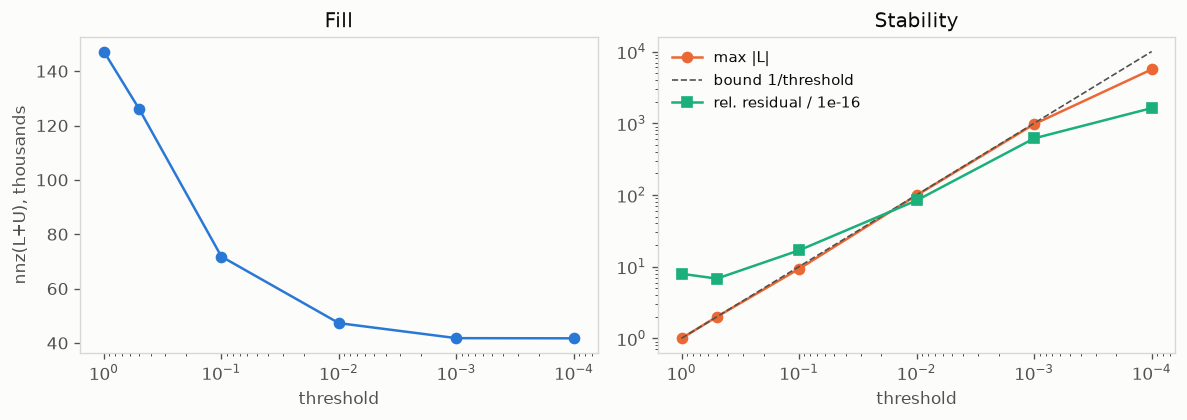
bound on growth: every entry of L is at most 1/threshold in magnitude.
The test matrix is a 40×40 grid with random unsymmetric weights and a diagonal weakened by a random factor in [0.05, 1]. Full pivoting leaves the diagonal at about half the columns:
def weak_diagonal(k, seed=0):
    rng = np.random.default_rng(seed)
    A = laplacian_2d(k) / 4.0
    A.data = A.data * rng.uniform(0.5, 1.5, A.nnz)
    d = A.diagonal()
    return (A - sp.diags(d) + sp.diags(d * rng.uniform(0.05, 1.0, k * k))).tocsr()


W = weak_diagonal(40)
n = W.shape[0]
x_true = np.random.default_rng(3).standard_normal(n)
b = W @ x_true
W64, W32 = ms.from_scipy(W), ms.from_scipy(W.astype(np.float32))

THRESHOLDS = (1.0, 0.5, 0.1, 0.01, 1e-3, 1e-4)
sweep = []
for t in THRESHOLDS:
    F = ms.splu(W64, ordering="amd", threshold=t)
    x = F.solve(b).to_numpy()
    F32 = ms.splu(W32, ordering="amd", threshold=t)
    _, info = iterative_refine(W64, F32, b, max_iter=30, rel_tol=1e-14)
    sweep.append(
        {
            "t": t,
            "nnz": F.nnz,
            "diagonal": np.mean(np.asarray(F.row_perm) == np.asarray(F.col_perm)),
            "max_L": np.abs(ms.to_scipy(F.L)).max(),
            "relres": relres(W, x, b),
            "fwd": fwd_err(x, x_true),
            "f32_iters": info["iters"],
            "f32_converged": info["converged"],
        }
    )

print(" threshold   nnz(L+U)  on diagonal  max|L|  rel. residual  fwd error  f32 refine")
for s in sweep:
    print(
        f"{s['t']:10g} {s['nnz']:10d} {s['diagonal']:12.0%} {s['max_L']:7.1e} "
        f"{s['relres']:14.1e} {s['fwd']:10.1e}  {s['f32_iters']} its"
    )
 threshold   nnz(L+U)  on diagonal  max|L|  rel. residual  fwd error  f32 refine
         1     147213          47% 1.0e+00        7.9e-16    1.1e-13  3 its
       0.5     126034          63% 2.0e+00        6.8e-16    9.6e-14  3 its
       0.1      71786          90% 9.3e+00        1.7e-15    3.9e-13  3 its
      0.01      47295          98% 9.9e+01        8.4e-15    1.3e-12  4 its
     0.001      41774          99% 9.7e+02        6.2e-14    2.7e-12  5 its
    0.0001      41714         100% 5.6e+03        1.6e-13    4.8e-12  5 its
fig, (ax1, ax2) = plt.subplots(1, 2, figsize=(10, 3.6))
ts = [s["t"] for s in sweep]
ax1.semilogx(ts, [s["nnz"] / 1e3 for s in sweep], "o-", color=SERIES[0])
ax1.set_xlabel("threshold")
ax1.set_ylabel("nnz(L+U), thousands")
ax1.set_title("Fill")
ax1.invert_xaxis()
ax2.loglog(ts, [s["max_L"] for s in sweep], "o-", color=SERIES[1], label="max |L|")
ax2.loglog(ts, [1 / t for t in ts], "--", color=INK_2, lw=1, label="bound 1/threshold")
ax2.loglog(ts, [s["relres"] / 1e-16 for s in sweep], "s-", color=SERIES[2], label="rel. residual / 1e-16")
ax2.set_xlabel("threshold")
ax2.set_title("Stability")
ax2.invert_xaxis()
ax2.legend(frameon=False, fontsize=9)
fig.tight_layout()
nnz = {s["t"]: s["nnz"] for s in sweep}
assert all(s["max_L"] <= (1 / s["t"]) * (1 + 1e-12) for s in sweep)  # the growth bound
assert nnz[1e-3] < 0.35 * nnz[1.0]  # about 3.5x less fill
assert sweep[0]["diagonal"] < 0.6 and sweep[-1]["diagonal"] > 0.95
assert all(s["relres"] < 1e-12 for s in sweep)
assert sweep[-1]["relres"] > 10 * sweep[0]["relres"]  # stability is what it costs
assert all(s["f32_converged"] for s in sweep)
assert sweep[0]["f32_iters"] < sweep[-1]["f32_iters"]
Going from 1 to 0.001 cuts the fill by about 3.5×. Entries of L grow up to the
1/threshold bound, and the residual grows by roughly two orders of
magnitude, though it stays near rounding error here. A float32 factor still
refines to full accuracy, but needs five iterations instead of three. Below 0.001 almost every pivot is already on the diagonal, so the
fill stops improving and only the growth bound keeps loosening.
SuperLU’s default is 1.0 for general matrices, and UMFPACK uses 0.1 for
unsymmetric strategies. A threshold between 0.1 and 0.01 is a common middle
ground when fill matters and the matrix is not badly scaled. KLU equilibrates
the rows first by default (scale=True), which makes the comparison against
the column maximum fairer on a badly scaled matrix.
others = {"klu": ms.klu, "supernodal_lu, amd": lambda A, **kw: ms.supernodal_lu(A, ordering="amd", **kw)}
for name, f in others.items():
    counts = [f(W, threshold=t).nnz for t in (1.0, 0.1, 0.01, 1e-3)]
    print(f"{name:>18}: nnz at threshold 1, 0.1, 0.01, 0.001 = {counts}")
    assert counts[-1] < 0.35 * counts[0]
               klu: nnz at threshold 1, 0.1, 0.01, 0.001 = [139021, 74695, 46374, 42087]
supernodal_lu, amd: nnz at threshold 1, 0.1, 0.01, 0.001 = [147213, 71786, 47295, 41774]
How much the threshold matters depends on the matrix. On west0479, under
COLAMD, it changes the fill by two entries, because full partial pivoting
already keeps close to the ordering there:
S = ms.to_scipy(mtl5.io.mm_read("../notebooks/data/west0479.mtx"))
S.eliminate_zeros()
west = {t: ms.splu(S, threshold=t).nnz for t in (1.0, 0.1, 0.01)}
print(west)
assert max(west.values()) < 1.05 * min(west.values())
{1.0: 6744, 0.1: 6744, 0.01: 6742}
Note
Before MTL5 5.24.1 the threshold preferred the wrong row under every ordering
except natural, so it barely changed fill
(stillwater-sc/mtl5#916).
mtl5-python requires 5.24.1 or later.
The accumulator#
splu, klu, supernodal_lu and supernodal_ldlt take
accumulator=, which sets the type of the dense workspace in which each
column’s updates are accumulated. A float32 factor built with
accumulator="f64" is still stored in float32: each entry of L and U is
rounded once, on the way out. What gets more precise is the arithmetic that
produced it, because the intermediate roundings inside each column’s update
chain disappear.
The choices are None (the element type), "f32", "f64", "fma32" and
"fma64". The effect is visible on a badly scaled matrix, with condition
number about 2.8·10¹⁰. It is the matrix the test suite uses for this:
rng = np.random.default_rng(1)
H = sp.random(400, 400, density=0.02, random_state=2, format="csr") + sp.eye(400) * 1e-3
H = (sp.diags(10.0 ** rng.uniform(-4, 4, 400)) @ H).tocsr()
xh_true = rng.standard_normal(400)
bh = H @ xh_true
H64, H32 = ms.from_scipy(H), ms.from_scipy(H.astype(np.float32))

print("ordering  accumulator  direct fwd error  refine iters  refined fwd error")
acc_rows = {}
for o in ("colamd", "amd", "natural"):
    for acc in (None, "f64"):
        F = ms.splu(H32, ordering=o, accumulator=acc)
        direct = fwd_err(F.solve(bh).to_numpy(), xh_true)
        x, info = iterative_refine(H64, F, bh, max_iter=30, rel_tol=1e-15)
        refined = fwd_err(np.asarray(x), xh_true)
        acc_rows[o, F.accumulator] = (direct, info["iters"], refined)
        print(f"{o:>8}  {F.accumulator:>11}  {direct:16.2e}  {info['iters']:12d}  {refined:17.2e}")

for o in ("colamd", "amd", "natural"):
    assert acc_rows[o, "f64"][0] < acc_rows[o, "default"][0]
    assert acc_rows[o, "f64"][2] < acc_rows[o, "default"][2]
    assert acc_rows[o, "f64"][1] <= acc_rows[o, "default"][1]
ordering  accumulator  direct fwd error  refine iters  refined fwd error
  colamd      default          8.19e-03             5           4.92e-11
  colamd          f64          6.39e-03             4           7.87e-12
     amd      default          5.35e-02             6           8.99e-12
     amd          f64          3.17e-02             5           3.11e-13
 natural      default          3.52e-02             7           6.89e-11
 natural          f64          1.39e-02             5           2.52e-13
The direct error improves by a modest 1.3–2.5×. The larger effect is on
refinement: a float64 accumulator takes one or two fewer iterations and ends
6 to 300 times closer, from a factor that occupies the same memory.
The direction holds on every platform the test suite runs on, but the size of
the gain varies between platforms. "fma32" is not consistently better than
the default, so it is not shown.
On a well-scaled matrix there is little to gain. When each column’s update chain is short and free of cancellation, rounding the stored factor dominates the error, and the accumulator cannot change that. Here it is even slightly worse:
Pn = laplacian_2d(32) / 4.0 + 1e-4 * sp.eye(32 * 32)
xp_true = np.random.default_rng(1).standard_normal(Pn.shape[0])
bp = Pn @ xp_true
P32 = ms.from_scipy(Pn.astype(np.float32))
e_default = fwd_err(ms.splu(P32).solve(bp).to_numpy(), xp_true)
e_f64 = fwd_err(ms.splu(P32, accumulator="f64").solve(bp).to_numpy(), xp_true)
print(f"default {e_default:.2e}, f64 {e_f64:.2e}")
assert 0.5 < e_f64 / e_default < 2
default 1.01e-06, f64 1.50e-06
Three combinations are refused rather than silently accepted:
refusals = {}
try:
    ms.splu(H64, accumulator="f32")
except ValueError as err:
    refusals["narrower than float64"] = str(err)
try:
    ms.splu(H32, accumulator="quire")
except ValueError as err:
    refusals["quire"] = str(err)
try:
    ms.splu(H32, accumulator="f64").refactor(H32)
except ValueError as err:
    refusals["refactor"] = str(err)
for k, v in refusals.items():
    print(f"{k}: {v}\n")
assert len(refusals) == 3

F = ms.supernodal_ldlt(ms.from_scipy(Pn.astype(np.float32)), accumulator="f64")
F.refactor(ms.from_scipy(Pn.astype(np.float32)))
assert F.accumulator == "f64"
narrower than float64: accumulator='f32'/'fma32' is narrower than the float64 element type, so it would lose precision rather than gain it. Use 'f64', 'fma64', or None for the element precision.

quire: accumulator='quire' is not available for the sparse factorizations: their numeric workspace holds one accumulator per row, and a quire<double> is 4226 bits wide. Use 'f64' or 'fma64' for a wider accumulator.

refactor: refactor: this factorization was built with accumulator='f64', and sparse_lu_refactor reuses the stored pivot sequence through an entry point that takes no accumulator -- it would silently drop back to element precision. Construct a new factorization instead.
An accumulator narrower than the element type would lose precision rather than gain it.
The quire is refused, because the workspace holds one accumulator per row and a 4226-bit quire there needs its own design.
refactor()onsplu,kluandsupernodal_lureplays the stored pivot sequence through an entry point that has no accumulator. Accepting it would quietly drop back to element precision, so it raises, and you construct a new factorization instead.supernodal_ldltre-runs the full numeric factorization onrefactor(), so it keeps the policy.
A checklist#
After a factorization, and before trusting its solve:
num_perturbed(LU family). If it is nonzero, the factor is of a perturbed matrix: check the refinement’sconvergedandrel_residual.The pivot ratio, from
ms.to_scipy(F.U).diagonal()forspluandsupernodal_lu, and fromdiagonal()forldltandsupernodal_ldlt. KLU exposes no factors, so for KLU use the detector below, together with a condition estimate. A ratio near the unit roundoff is a warning, whether or not anything raised. Follow it up with a condition estimate, because the ratio alone does not establish singularity. On the LU factorizations (splu,klu,supernodal_lu), a quick detector is a smallpivot_perturb, then readingnum_perturbed. It flags pivots that cancelled within their column; a count of zero does not rule out a badly scaled or ill-conditioned matrix. The LDLᵀ factorizations have nopivot_perturb; read their diagonal.The residual of the solve you care about, in float64. It is cheap, and it is what refinement minimizes. It bounds the forward error only through κ (error ≲ κ × residual), so weigh it against the conditioning and the accuracy you need.
nnzagainstA.nnz, andnblocksornsuperfor KLU and supernodal LU. These tell you whether the ordering, the threshold and the block structure did what you expected. The orderings guide shows what good and bad fill look like.dtypeandaccumulator, when the factor came from code you did not write. The repr shows the accumulator, and the class name’s suffix shows the dtype.
API reference: mtl5.sparse.splu(), mtl5.sparse.klu(),
mtl5.sparse.supernodal_lu(), mtl5.sparse.cholesky(),
mtl5.sparse.ldlt(), mtl5.sparse.supernodal_ldlt(),
mtl5.sparse.qr(), mtl5.mixed.iterative_refine().