LNS log-domain add/sub algorithms
This document gives the mathematical derivation of the seven add/sub algorithms
that Universal’s lns template ships with, the transfer functions they
approximate, and a decision tree for picking one for a given target.
It is the educational companion to:
- the implementation at
include/sw/universal/number/lns/lns_addsub_algorithms.hpp - the design rationale at
docs/design/lns-add-sub.md - the per-iteration CORDIC convergence study at
docs/design/cordic-precision-assessment.md - the per-algorithm benchmark at
benchmark/performance/arithmetic/lns/log_add_algorithms.cpp
All formulae are written in ASCII; mathematical symbols use the conventions
listed in the project CLAUDE.md (log2, ^ for power, <= for less-or-equal,
-> for limits, 2^x for pow(2, x)).
1. Why log-domain addition is the hard case
Section titled “1. Why log-domain addition is the hard case”In the logarithmic number system, a real value x > 0 is encoded by its
log: L_x = log2(x). Multiplication and division become integer-grade
operations on the encoded exponent:
x * y -> L_x + L_yx / y -> L_x - L_yx^k -> k * L_xAddition is the difficulty. There is no closed-form expression for
log2(x + y) in terms of L_x and L_y alone – you must cross back into
the linear domain through a transcendental. The Gauss log-add formulation
makes the irreducible work explicit. For two same-sign positive values
a, b with L_a >= L_b:
log2(a + b) = log2(2^L_a + 2^L_b) = log2( 2^L_a * (1 + 2^(L_b - L_a)) ) = L_a + log2(1 + 2^d), d = L_b - L_a <= 0 = L_a + sb_add(d)The correction term sb_add(d) = log2(1 + 2^d) is a one-dimensional, smooth,
monotone non-increasing function of d over d <= 0. For mixed-sign
operands the analogous correction is sb_sub(d) = log2(1 - 2^d), which has
a vertical tangent (catastrophic cancellation) as d -> 0- and equals
-inf exactly at d = 0 (the a + (-a) = 0 case).
So the entire question of “how to add in log space” reduces to: how do you
evaluate sb_add(d) and sb_sub(d). The rest – sign routing, special
values, encode / decode – is bookkeeping that all seven algorithms share
via the detail::gauss_log_add dispatcher.
Naming note
Section titled “Naming note”Universal’s policy class API uses the prefix sb_ (read as “sum-base”). The
LNS literature uses different conventions: Coleman et al. (European
Logarithmic Microprocessor) write phi(z) = log_b(1 + b^z) and
psi(z) = log_b(1 - b^z); Arnold et al. write F+(d) and F-(d). The sb_
prefix is Universal-internal – it is not a standard literature term.
2. The reference transfer functions
Section titled “2. The reference transfer functions”The two correction functions that every algorithm approximates:
sb_add(d) = log2(1 + 2^d)
Section titled “sb_add(d) = log2(1 + 2^d)”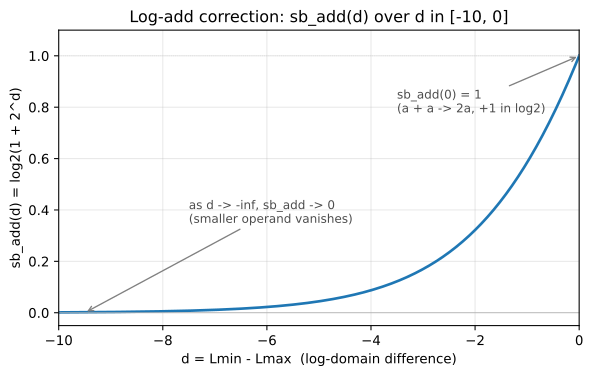
Properties:
sb_add(0) = 1: a + a = 2a, which is+1inlog2.sb_add(d) -> 0asd -> -inf: the smaller operand vanishes in the log domain once it is many orders smaller than the larger.- Always positive over
d <= 0. - Smooth, monotone non-increasing.
sb_sub(d) = log2(1 - 2^d)
Section titled “sb_sub(d) = log2(1 - 2^d)”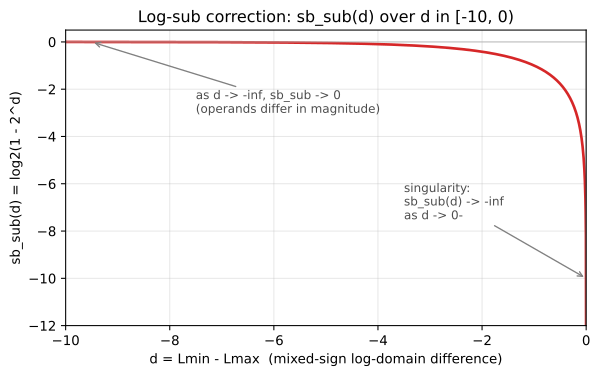
Properties:
sb_sub(d) -> -infasd -> 0-: this is the cancellation singularity. When two same-magnitude values of opposite sign cancel, the result is zero, which is-infin log space.sb_sub(d) -> 0asd -> -inf: at large magnitude separation, the subtraction barely perturbs the larger operand.- Always negative over
d < 0. - Smooth and monotone away from
d = 0, but unbounded slope at the origin – this is what makes LNS subtraction the textbook hard case.
The “all of LNS add/sub” picture is: pick a way to evaluate these two functions cheaply and accurately, and you have an LNS adder. Every shipped algorithm is a different point on the (accuracy, table size, latency, hardware-mapping) trade-off surface for that one job.
3. The shared dispatcher
Section titled “3. The shared dispatcher”Every policy plugs into the same special-value router:
template<typename Policy>constexpr double gauss_log_add(double a, double b) { // 1. NaN propagation, +/-0 short-circuits, +/-inf delegated to native double // 2. Sign dispatch: same-sign -> sb_add path, mixed-sign -> sb_sub path // 3. Cancellation check for mixed-sign: La == Lb -> exact 0 // 4. Encode-back via cm::exp2 with policy-supplied sb_add / sb_sub}A new algorithm therefore only needs:
template<typename Lns>struct MyAddSub {    static constexpr double sb_add(double d);   // log2(1 + 2^d), d <= 0    static constexpr double sb_sub(double d);   // log2(1 - 2^d), d <  0
    static constexpr Lns& add_assign(Lns& lhs, const Lns& rhs);    static constexpr Lns& sub_assign(Lns& lhs, const Lns& rhs);};
The customization point is the traits class
lns_addsub_traits<Lns>, specialised per instantiation. The default selects
DoubleTripAddSub for backward compatibility; user code switches by
specialising the trait.
4. The seven algorithms
Section titled “4. The seven algorithms”4.1 DoubleTripAddSub (default, correctness baseline)
Section titled “4.1 DoubleTripAddSub (default, correctness baseline)”a + b: decode both to double, native double add, encode back.Pays a full encode/decode for every operation. Useful as a correctness
oracle that all other algorithms can be cross-validated against. Slow on
purpose: it does the exact work an LNS exists to avoid (an exp2 and a
log2 per add). The default of the configurable framework so that legacy
lns<> users see no behavioural change after the framework landed.
4.2 DirectEvaluationAddSub (high-precision software default)
Section titled “4.2 DirectEvaluationAddSub (high-precision software default)”sb_add(d) = log2(1 + exp2(d))sb_sub(d) = log2(1 - exp2(d)) for d < 0Implements the Gauss log-add formulation directly using
sw::math::constexpr_math::log2 and cm::exp2. Two transcendentals per
add, no approximation. Accuracy is dominated by the cm::log2/cm::exp2
implementations (a few ULP at double precision). The recommended default
for high-precision software targets, and the oracle the other policies are
benchmarked against.
4.3 LookupAddSub (Mitchell 1962, the original)
Section titled “4.3 LookupAddSub (Mitchell 1962, the original)”The original LNS-add algorithm: precompute sb_add on a finite grid of d
values at compile time, then look up and linearly interpolate at runtime.
table_entries = 2^IndexBitsd_range       = rbits + 2                  // past this sb_add < 1 ULPstep          = d_range / table_entriesadd_table[i]  = log2(1 + 2^(-i*step))      i = 0..table_entries
sb_add(d):    abs_d = -clip(d, -inf, 0)    if abs_d >= d_range: return 0    idx_f = abs_d / step    idx   = floor(idx_f)    frac  = idx_f - idx    return add_table[idx] + frac * (add_table[idx+1] - add_table[idx])
Default IndexBits = min(rbits + 2, 10): caps the table at 1024 entries
(8 KB doubles) so a 64-bit lns does not try to allocate a 4-million-entry
table. Users raise IndexBits for tighter accuracy.
sb_sub is the same idea, except the lowest cell (|d| < step) falls
back to direct cm::log2 / cm::exp2: linear interpolation across the
cancellation singularity has unbounded error. This is a common pattern –
five of the seven algorithms use the same direct-eval fallback in
d in (-1, 0).
References: Mitchell 1962 (the foundational paper).
4.4 PolynomialAddSub (closed-form, no table)
Section titled “4.4 PolynomialAddSub (closed-form, no table)”Uses the classical log-domain identity
log2( (1+x) / (1-x) ) = (2 / ln 2) * ( x + x^3/3 + x^5/5 + x^7/7 + ... )With the substitution (1+x)/(1-x) = 1 + u, where u = 2^d in (0, 1], we
get x = u / (2 + u) in (0, 1/3]. The series in odd powers of x then
converges rapidly: |x|^9 / 9 <= (1/3)^9 / 9 ~ 5.6e-6 over the entire
domain, so degree-7 truncation gives ~5.6e-6 absolute error in the
log domain.
u = 2^d // 2^d in (0, 1]x = u / (2 + u) // in (0, 1/3]sb_add(d) ~ c1 * x + c3 * x^3 + c5 * x^5 + c7 * x^7 where c_k = 2 / (k * ln 2)For sb_sub the analogous substitution is x = u / (2 - u), valid for
u <= 0.5 (i.e. d <= -1). Past that the series diverges – so the
d in (-1, 0) band uses the direct-eval fallback.
Cost: one transcendental at runtime (the 2^d), one division, plus a
handful of muls and adds for the polynomial. No table.
4.5 ArnoldBaileyAddSub (piecewise-linear, zero transcendentals)
Section titled “4.5 ArnoldBaileyAddSub (piecewise-linear, zero transcendentals)”Cheapest of the family: piecewise-linear approximation matching the function at integer-d knots.
knots for sb_add:    d =  0: 1.000000   (= log2(2))    d = -1: 0.584963   (= log2(1.5))    d = -2: 0.321928   (= log2(1.25))    d = -3: 0.169925   (= log2(1.125))    d = -4: 0.087463   (= log2(1.0625))    d = -5: 0.044394   (= log2(1.03125))    d in [-6, -5]: secant ramp from f_at_minus5 down to 0    d <= -6: 0 exact
within interval [k-1, k]: sb_add(d) ~ secant interpolation
Each evaluation is a single a + b*d – two muls, one add, no
transcendentals, no division. Worst-case error is bounded by the curvature
of log2(1 + 2^d), which is largest near d = 0 (~2.5% relative) and
drops rapidly as d -> -inf.
The shipped knot set is intentionally coarse and hand-readable. Production LNS implementations of the Arnold/Bailey family use finer fractional spacing with higher-order interpolation when accuracy matters; the implementation here is “in the style of” that family rather than a port of any single paper.
References:
- Kingsbury & Rayner 1971, “Digital filtering using logarithmic arithmetic”
- Arnold, Bailey, Cowles, Winkel 1998, IEEE TC 47(7), 777-786
- Arnold & Walter 2001, “Unrestricted faithful rounding is good enough for some LNS applications,” Proc. 15th IEEE Symp. on Computer Arithmetic.
4.6 CORDICAddSub (hardware-codesign tier)
Section titled “4.6 CORDICAddSub (hardware-codesign tier)”Classical hyperbolic CORDIC: one iteration per bit of precision, only adds,
shifts, and a small table of atanh(2^-k) constants. Two passes:
Pass 1, rotation mode: compute v = 2^d via exp(d * ln 2). Range
reduction d = q + f (integer + fractional) so only the fractional part
goes through CORDIC; the 2^q factor is a binary shift.
x, y, z := 1, 0, z0for i in 1..N: sigma := sign(z) x_new := x + sigma * y * 2^-i y_new := y + sigma * x * 2^-i z_new := z - sigma * atanh(2^-i)after N iters: (x + y) ~ K_h * exp(z0) (K_h ~ 1.20749 = hyperbolic gain)Pass 2, vectoring mode: compute log2(1 +/- v). Drive y to zero
starting from (w + 1, w - 1, 0); final z = ln(w) / 2.
Convergence quirk: hyperbolic CORDIC requires repeating iterations at
indices 4, 13, 40, ... (the recurrence r_{k+1} = 3*r_k + 1, r_0 = 4).
Without those repeats the per-iteration angle radius drops below the
residual remaining-z range past index 4 and the iteration fails to
converge. The implementation handles all three repeats that fit in software
budgets (MaxIterations <= 60).
template<typename Lns, unsigned MaxIterations = Lns::rbits>struct CORDICAddSub { ... };MaxIterations is exposed so a hardware-codesign team can sweep truncated
iteration budgets independently of rbits.
Why CORDIC in software? It is the wrong choice on a CPU: one dependent iteration per rbit, no SIMD parallelism. The reason it ships is the reason it is named the “hardware-codesign tier”: on FPGA / ASIC each CORDIC iteration is one cycle of a fully-bypassed datapath with no transcendental hardware. The software implementation lets a hardware-codesign consumer characterize the iteration-budget vs accuracy curve in advance of silicon commitment.
The convergence curve has the classical “one bit per iteration” shape:
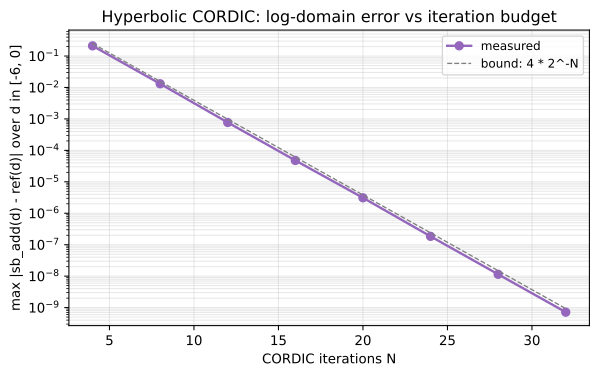
The 4 * 2^-N engineering bound (dashed) is the tolerance Universal’s
trait lns_addsub_log_error_bound<CORDICAddSub> advertises to consumer
regression tests.
Cancellation regime: sb_sub(d) for d in (-1, 0) uses the same
cm::log2 / cm::exp2 fallback as the other policies. At low
MaxIterations the residual exp error exceeds the true magnitude of
u - 1 near the singularity, and the chain produces invalid arguments to
log2. Hardware retargets would substitute a cotransformation or small
lookup – not a transcendental.
4.7 ArnoldCotransformationAddSub (fast + faithful rounding)
Section titled “4.7 ArnoldCotransformationAddSub (fast + faithful rounding)”Implements the Novel Cotransformation Combination from
P. D. Vouzis, S. Collange, M. G. Arnold, “A Novel Cotransformation for LNS Subtraction,” J. Signal Processing Systems, 58(1), 29-40, 2010. DOI: 10.1007/s11265-008-0282-7.
Fills the fast + faithful-rounding quadrant: ~1 ULP of
DirectEvaluation across the full d domain (including the cancellation
regime that defeats Lookup / Polynomial / ArnoldBailey), with zero runtime
transcendentals.
The cotransformation idea. As d -> 0-, sb_sub(d) has a vertical
tangent: any low-order polynomial or coarse-grained LUT blows up. Lewis
(1995) reports needing 10x more table storage to interpolate sb_sub than
sb_add to the same accuracy. The Coleman / Arnold / Vouzis line of
cotransformations re-expresses sb_sub(d) as a combination of sb_sub and
sb_add evaluations whose arguments are bounded away from the singularity.
The expensive interpolation is then only ever performed in the well-behaved
domain.
Novel Combination. The dispatcher passes d <= 0. Let z = -d > 0.
Split
z = z_h + z_l, z_h = floor(z / delta_h) * delta_h, z_l in [0, delta_h)delta_h = 2^(j - f), j = SplitJ, f = rbits.Precompute two LUTs at compile time:
F3(z_l) = log2(1 - 2^(-z_l)) for z_l in [0, delta_h) (size 2^j)F4(z_h) = log2(1 - 2^(-z_h)) for z_h in [delta_h, e_F4] (size ~(f+2) * 2^(f-j))The runtime evaluation is
sb_sub(d) = F4(z_h) + sb_add( F3(z_l) - F4(z_h) - z_h )with two special cases:
idx_h == 0(z < delta_h): result isF3(z_l)directly.z_l == 0(z exact multiple of delta_h): result isF4(z_h)directly.
The argument to sb_add is guaranteed negative when z_h > z_l > 0 (the
common case), so it lands in sb_add’s safe domain. sb_add itself uses
the same Mitchell-style table as LookupAddSub – there is no singularity
to dodge there.
Default SplitJ: the paper’s memory-minimization formula gives
j_opt = (f + log2(f+2)) / 2 ~ (f + 4) / 2. Default
SplitJ = clamp((f + 4) / 2, 2, 10) – floor of 2 to keep the F3 table
non-trivial at small rbits, ceiling of 10 to keep F3 within 1024 entries
(beyond which clang’s default -fconstexpr-steps budget is exceeded
during table generation).
LUT sizes (example: lns<32,16>, IndexBits=10, j=10):
F3: 2^10 = 1024 entriesF4: ~(16+2) * 2^(16-10) = ~1152 entriessb_add: 2^10 = 1024 entriestotal: ~3200 doubles = ~25 KBThe advertised log-domain bound is 2 * 2^-rbits (one ULP at the encoding
precision) – matching the “faithful rounding” target.
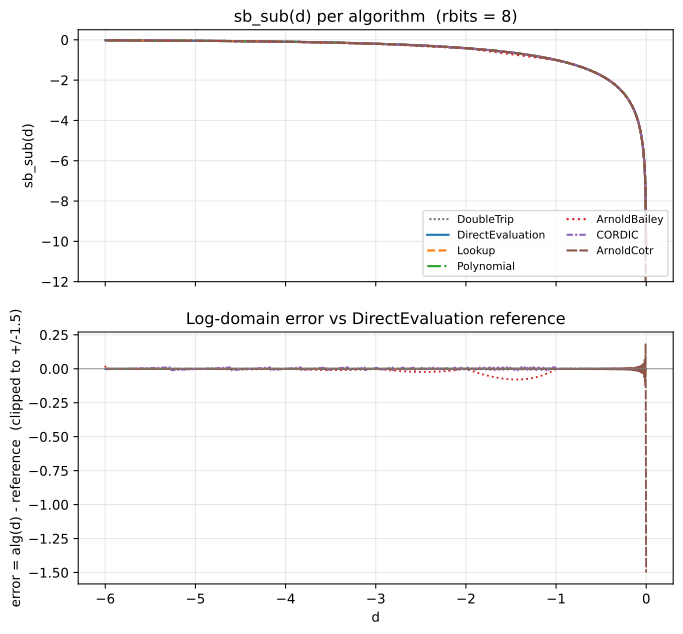
5. Algorithm overlay
Section titled “5. Algorithm overlay”The four cheap algorithms (Lookup, Polynomial, ArnoldBailey, ArnoldCotr)
relative to DirectEvaluation look like this at the two most common rbits:
rbits = 8
Section titled “rbits = 8”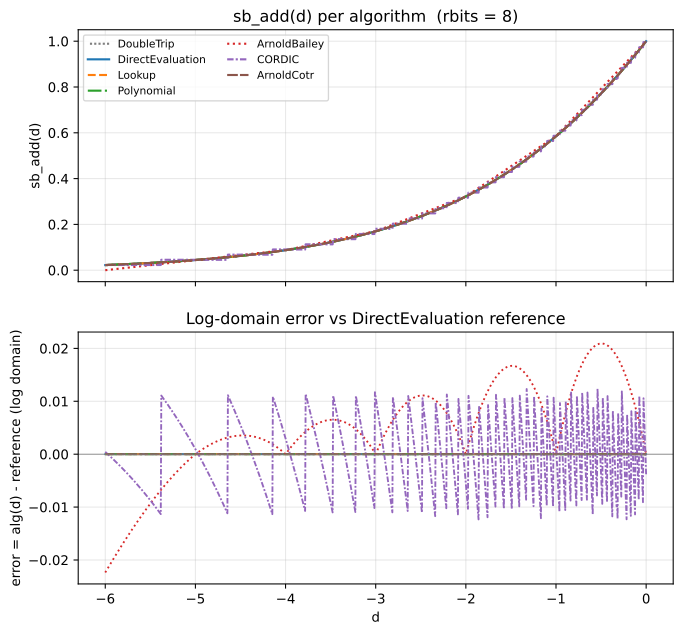
rbits = 16
Section titled “rbits = 16”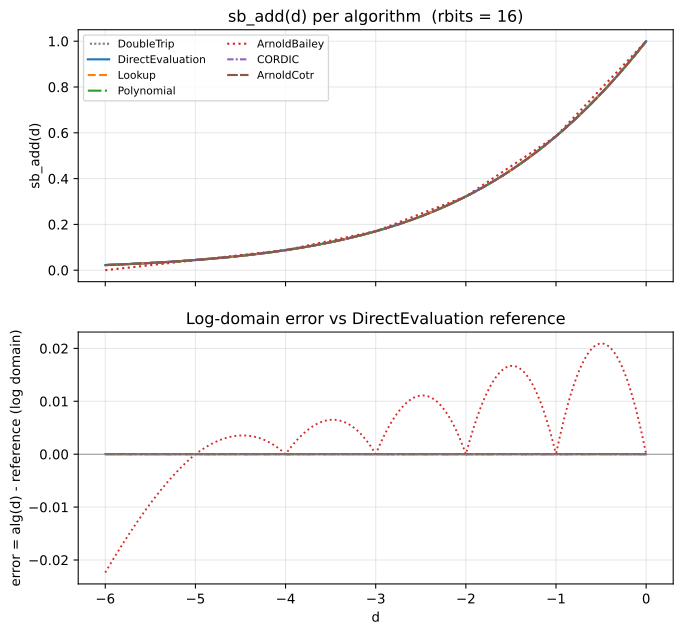
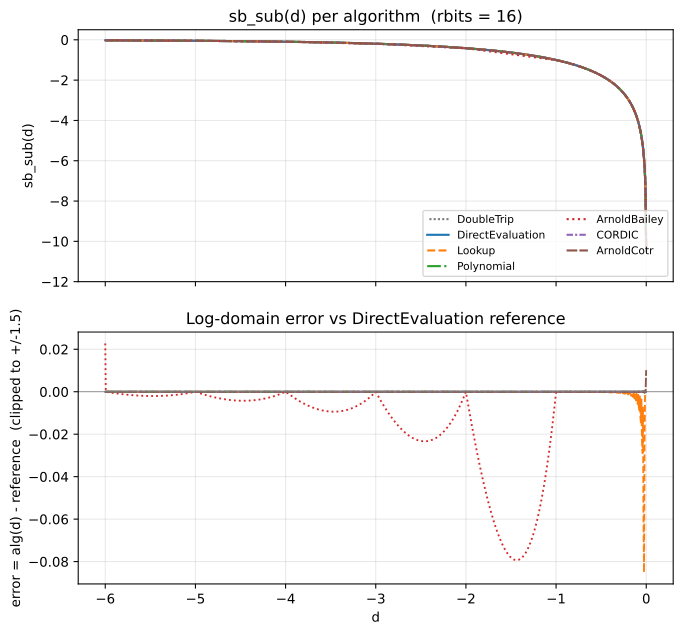
The sb_add overlay (top of each pair) is visually almost a single line –
all algorithms hit the smooth target to plotting precision. The error panel
(bottom) is where the algorithms separate: ArnoldBailey’s piecewise-linear
secant has visible kinks at every integer knot, with maximum deviation in
the d in [-1, 0] interval where the function curvature is largest.
The sb_sub overlay is where the cancellation regime visibly hurts: the
cheap algorithms all rely on the direct-evaluation fallback for
d in (-1, 0), so they track the reference there. The error band for
ArnoldBailey grows near d = -1 (the boundary between fallback and
piecewise-linear regions); Lookup and Polynomial are bounded by their
respective envelopes.
6. Error envelope vs rbits
Section titled “6. Error envelope vs rbits”The single most useful plot for picking an algorithm:
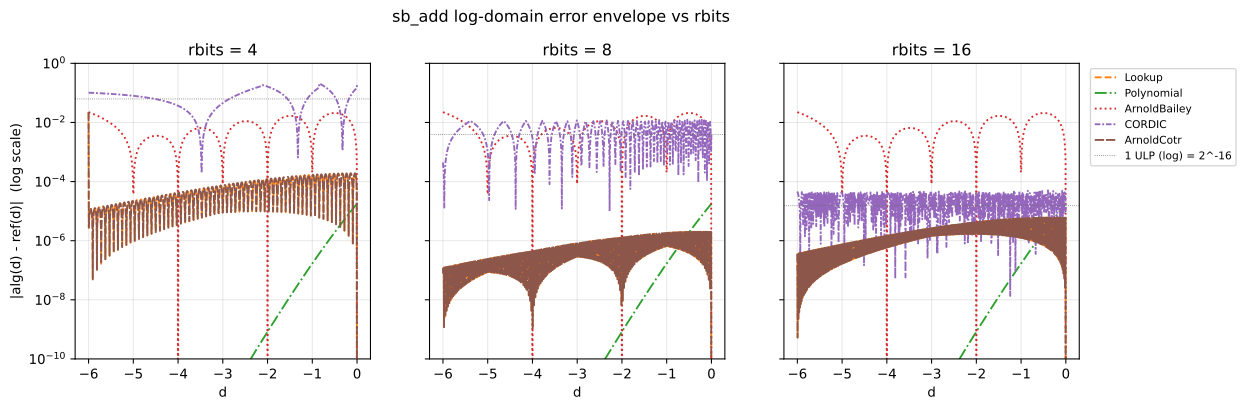
The horizontal dotted line in each panel is one log-domain ULP at that
rbits (i.e. 2^-rbits). An algorithm whose error curve dips below the
ULP line is better than the encoding can represent at that rbits: the
encoding rounds the algorithm’s output, so its real contribution is zero.
An algorithm whose error curve stays above the ULP line is the dominant
error source for that instantiation.
Reading the panels:
- rbits = 4: every algorithm except CORDIC sits well above ULP – the encoding is so coarse that even ArnoldBailey’s 2.5% bound is within ULP budget. CORDIC with only 4 iterations has not completed its first required repeat (at index 4) and is the dominant error source.
- rbits = 8: ArnoldBailey’s secant envelope hovers around ULP; Lookup and Polynomial are well below. CORDIC at 8 iterations is now competitive.
- rbits = 16: ArnoldBailey is now ~10 ULP over budget across the range; Polynomial is at-budget; Lookup and ArnoldCotr are below. At this rbits, choosing ArnoldBailey is a deliberate trade – “I want zero transcendentals and accept 2.5% relative error.”
7. Picking an algorithm
Section titled “7. Picking an algorithm”| If your target … | use |
|---|---|
| just needs the lns API to work, no perf concern | DoubleTripAddSub (default) |
| needs full precision, can afford 2 transcendentals per op | DirectEvaluationAddSub |
| has SRAM for a 1-8 KB table, wants ~1e-4 log-domain error | LookupAddSub (default IndexBits) |
| has SRAM for > 100 KB, wants 1-2 ULP | LookupAddSub<Lns, 16+> |
| is SRAM-constrained, wants ~5e-6 abs error, ok with 1 transcendental | PolynomialAddSub |
| is energy-constrained, no transcendentals, ok with ~2.5% rel error | ArnoldBaileyAddSub |
| is FPGA / ASIC and wants the matching cost model | CORDICAddSub (or CORDICAddSub<Lns, K> for a truncated budget) |
| wants software-fast AND faithful rounding | ArnoldCotransformationAddSub |
8. Interpreting the benchmark output
Section titled “8. Interpreting the benchmark output”If you run benchmark/performance/arithmetic/lns/log_add_algorithms.cpp
across a sweep of configurations, you will see enormous absolute errors
in the table – numbers like 1.51e+17 for ArnoldBailey on lns<16,8>.
These are not bugs. The benchmark samples operands geometrically across
the entire lns dynamic range and reports |alg(a,b) - ref(a,b)| in
value domain. lns<16,8> covers magnitudes up to ~2^127 ~ 1.7e+38, so a
1.5% relative error at the top of that range is ~1e+17 absolute.
The numbers that tell you something useful are:
- Max relative error: should be at or below the per-algorithm advertised
bound. ArnoldBailey at ~1.6% on
lns<16,8>is within its 2.5% envelope. inf_both: both algorithm and oracle saturated to+/-infon decode-to-double for comparison. Expected when the lns dynamic range exceeds double’s (e.g.lns<32,16>covers2^[-16384, 16383]vs double’s2^1024).inf_one_sided: only one side saturated. This is a real divergence – usually a tiny algorithm error pushing a near-overflow result over the double-representable cliff.
The “what to expect for my (algorithm, rbits) pair” reference is the error envelope plot in section 6. If a benchmark cell exceeds that envelope, you have found a real bug. If it sits within the envelope, the absolute number is just relative-times-magnitude and is the expected behaviour for that configuration.
9. Validation
Section titled “9. Validation”Each algorithm advertises a log-domain error bound via the
lns_addsub_log_error_bound trait. Consumer regression tests derive a
value-domain tolerance from that bound and the LnsType’s rbits, via
log_ulp = 2^-rbits // one ULP in log domainulp_shift = (log_domain_error / log_ulp) + 2 // +2 for boundary roundingrel_tol = 2^(ulp_shift * log_ulp) - 1 // value-domain relative toleranceThis is exposed as the helper lns_eq_within_alg_tolerance(c, cref).
Bit-exact comparison is the default (zero tolerance) when the active
algorithm is DoubleTripAddSub or DirectEvaluationAddSub. The shipped
bounds are:
| Algorithm | Log-domain bound | Source |
|---|---|---|
| DoubleTripAddSub | 0 | exact via native double |
| DirectEvaluationAddSub | 0 | oracle by construction |
| LookupAddSub | 1e-4 | linear-interp at default IndexBits |
| PolynomialAddSub | 1e-5 | degree-7 truncation (x^9/9 at x=1/3) |
| ArnoldBaileyAddSub | 2.5e-2 | piecewise-linear secant worst case |
| CORDICAddSub<Lns, N> | 4 * 2^-min(N, 60) |
hyperbolic CORDIC engineering envelope |
| ArnoldCotransformationAddSub | 2 * 2^-rbits |
faithful rounding (Vouzis 2010) |
10. Files
Section titled “10. Files”include/sw/universal/number/lns/lns_addsub_algorithms.hpp– all seven algorithm policies + traits class +detail::gauss_log_adddispatcherinclude/sw/universal/number/lns/lns_impl.hpp–operator+=/operator-=delegate tolns_addsub_algorithm_t<lns>::add_assign/sub_assignstatic/logarithmic/lns/arithmetic/log_add_algorithms.cpp– cross-validation regression suite (algorithm vs algorithm, corner cases, cancellation tier)benchmark/performance/arithmetic/lns/log_add_algorithms.cpp– per-algorithm throughput + accuracy benchmarkbenchmark/accuracy/lns/cordic_precision_assessment.cpp– per-iteration convergence study, ULP histograms, worst-case witness table forCORDICAddSubdocs/algorithmic-details/scripts/generate_lns_plots.py– the script that generated the SVGs in this document; rerun whenever the algorithms or default parameters change
References
Section titled “References”- Mitchell, J. N. (1962). “Computer multiplication and division using binary logarithms.” IRE Transactions on Electronic Computers, EC-11(4), 512-517.
- Kingsbury, N. G., Rayner, P. J. W. (1971). “Digital filtering using logarithmic arithmetic.” Electronics Letters, 7(2), 56-58.
- Arnold, M. G., Bailey, T. A., Cowles, J. R., Cuthbertson, K. (1990). “An Improved Logarithmic Number System Architecture.” Journal of VLSI Signal Processing, 1(1), 13-20.
- Coleman, J. N. (1995). “Simplification of Table Structure in Logarithmic Arithmetic.” IEE Electronics Letters, 31, 1905-1906.
- Arnold, M. G., Bailey, T. A., Cowles, J. R., Winkel, M. D. (1998). “Arithmetic Co-Transformations in the Real and Complex Logarithmic Number Systems.” IEEE TC, 47(7), 777-786.
- Coleman, J. N., Chester, E. I., Softley, C. I., Kadlec, J. (2000). “Arithmetic on the European Logarithmic Microprocessor.” IEEE Transactions on Computers, 49(7), 702-715.
- Arnold, M. G. and Walter, J. (2001). “Unrestricted faithful rounding is good enough for some LNS applications.” Proc. 15th IEEE Symposium on Computer Arithmetic, 237-246.
- Arnold, M. G. (2002). “An Improved Cotransformation for Logarithmic Subtraction.” Proc. ISCAS’02, 752-755.
- Vouzis, P., Collange, S., Arnold, M. (2007). “Cotransformation Provides Area and Accuracy Improvement in an HDL Library for LNS Subtraction.” Proc. 10th EUROMICRO DSD, 85-93.
- Vouzis, P. D., Collange, S., Arnold, M. G. (2010). “A Novel Cotransformation for LNS Subtraction.” J. Signal Processing Systems, 58(1), 29-40. DOI: 10.1007/s11265-008-0282-7.