QR and least squares across number systems
mp-numerics#14, part 1 of 6, in the series that stillwater-sc/mtl5#666 tracks. The
operator study (#13, ../givens_householder/) measured one Givens rotation or
one Householder reflector at a time. This one measures the factorizations
built from them. It factors the same matrices in each number type by QR and
solves the same least-squares problems by QR and by the normal equations. It
then asks where each type stops being usable, and whether the method or the
type decides that.
Part 1 covers the hardware IEEE types, posits and fixed point, 12 types in all. Part 2 adds the cfloat matrix, lns, takum, dd and qd. The later parts cover Hessenberg and Schur, the SVD, banded and sparse inputs, and the findings note for the MTL5 docs.
Running it
Section titled “Running it”cmake --build build --target decompositions_study./build/benchmarks/linalg/decompositions/decompositions_study results/python3 benchmarks/linalg/decompositions/summarize.py results/python3 benchmarks/linalg/decompositions/plot.py results/ figures/- Options:
--quickruns a small sample.--family ieee,posit,fixpntpicks families; all of them run by default. - Run time: the full run takes about 11 minutes on one core. Most of it is the exact measurement and the qd condition numbers at n = 16 and 32 × 16.
- Sidecars: each CSV has a
.sysinfosidecar, as in #13. It records the platform, the compiler, the sample counts, and the commits of mp-numerics, MTL5 and Universal, read when CMake configures. - Determinism: the committed results were made with GCC 15 on x86-64. The
--quickCSVs are byte-identical between GCC 15 and Clang 21 there. A compiler that fuses a·b + c into an FMA (Clang on AArch64) changes the roundings, and with them the last digits. - Dependencies:
plot.pyneeds matplotlib;summarize.pyneeds only the standard library.
What is measured
Section titled “What is measured”The matrices
Section titled “The matrices”Every matrix is generated in qd (212 bits) and rounded once into each type, so
all twelve types factor the same matrices. Each error is measured against the
matrix the type actually stores, not the qd original. Rounding into a narrow
type can change the condition number a lot: Hilbert 8 × 8 has κ = 1.5×10¹⁰ in
qd, 1.2×10⁷ once stored as posit<16,2>, and 9.6×10³ as fixpnt<16,8>. So the
CSVs carry both the generated κ and kappa_stored, the stored matrix’s
condition number computed in qd.
| class | A | κ |
|---|---|---|
randsvd | U Σ Vᵀ, with U and V random orthogonal and σᵢ = κ^(−i/(n−1)) | 10⁰ to 10²⁴ by decades; a type stops 4 decades past 1/ε |
graded | U Σ: orthonormal columns scaled from 1 down to 1/κ | as randsvd |
kahan | U K, with K = diag(sⁱ)(I − c N), s = sin θ, c = cos θ, N the strictly upper ones; R is K up to signs | θ = 1.2, 0.8, 0.4, 0.2 |
hilbert | 1/(i + j + 1) | fixed by the size |
- Random orthogonal factors: Q of a matrix of uniforms in [−1, 1), with R’s
diagonal made positive so that the distribution doesn’t depend on the signs
qr_factorpicks. - Seeds: inputs come from
std::mt19937_64, seeded with an FNV-1a hash of the class, the size, the parameter and the sample index, as in #13. The seed doesn’t depend on the type, so every type sees the same matrices. - Samples: eight per (class, size, parameter); Hilbert has one.
- Rounding into a type: a qd value is rounded by summing its two leading limbs in the type. That can round twice, but nothing depends on it, because every error is measured against the stored value.
QR runs on square 8 × 8 and 16 × 16 matrices. Least squares runs on 16 × 8 and
32 × 16. Each least-squares problem has a right-hand side b = A x for a random
unit x (zero residual), and one with a residual r orthogonal to range(A),
where ‖r‖ = ‖A x‖ (large, θ = 45°).
The methods
Section titled “The methods”| QR | what it is |
|---|---|
householder_mtl5 | mtl::qr_factor, dlarfg’s sign and power-of-two scaling (MTL5 5.22.0); Q from qr_extract_Q |
householder_beta | the same reflectors, but R(j,j) is set to the reflector’s β, as dgeqr2 does, instead of recomputed; sw::mp_numerics::qr_factor_stored_beta, the remedy tested (see Findings) |
householder_textbook | mtl::qr_factor(A, tau, tag::textbook_reflector): v = x − αe₁, unscaled and unnormalized |
givens_mtl5 | sw::mp_numerics::givens_qr, column by column and bottom up, with rotations from MTL5’s mtl::math::givens_rotation |
| least squares | what it is |
|---|---|
qr_householder | mtl::qr_factor, then mtl::qr_solve |
qr_householder_beta | qr_factor_stored_beta, then mtl::qr_solve |
qr_givens | sw::mp_numerics::givens_qr_solve: Qᵀb by the same rotations, then back substitution |
normal_equations | AᵀA and Aᵀb formed in the type, then mtl::cholesky_factor and mtl::cholesky_solve |
MTL5 has no Givens QR. givens_qr takes its rotations from MTL5, so a
difference from householder_mtl5 comes from the method, not the rotation.
The measures
Section titled “The measures”| column | meaning |
|---|---|
bwd | ‖A − QR‖_F / ‖A‖_F |
bwd_col | maxⱼ ‖(A − QR) eⱼ‖ / ‖A eⱼ‖, the columnwise backward error that Householder QR is proved to bound (Higham, Accuracy and Stability, Thm. 19.4) |
orth | ‖QᵀQ − I‖_F |
fwd | ‖x − x_ref‖ / ‖x_ref‖, where x_ref is the least-squares solution of the stored problem, by Householder QR in qd |
q_identity | samples where Q came back exactly I |
skipped | samples where some reflector was the identity (τ = 0), leaving its column as it was |
nonfinite | samples with an infinity or NaN in the result |
thrown | samples where the type threw. Here that means a fixed-point division by zero (see Findings) |
breakdown | normal equations: Cholesky found AᵀA not positive definite in the type |
singular | the stored A is rank deficient in qd, so the problem has no unique solution. All methods skip it |
bwd, bwd_col and orth are formed exactly. Q, R and A are read out as
Shewchuk expansions (exact.hpp), every entry of A − QR and QᵀQ − I is summed
exactly, and the result is rounded once to double. The rows give the maximum
and the median over the samples, and the tables quote them in units of the
type’s epsilon().
The types
Section titled “The types”| family | types |
|---|---|
| IEEE | float, double, long double (x87 80-bit here) |
| posit | posit<8,2>, posit<16,2>, posit<32,2>, posit<64,2>, posit<16,1> |
| fixpnt | fixpnt<16,8> and fixpnt<32,16>, each modulo and saturating |
fixpnt is built with FIXPNT_THROW_ARITHMETIC_EXCEPTION. Universal’s default
is to print fixpnt_divide_by_zero and return maxpos (saturating) or 0
(modulo), which no later test can tell from a result.
Findings
Section titled “Findings”IEEE: what the textbooks predict
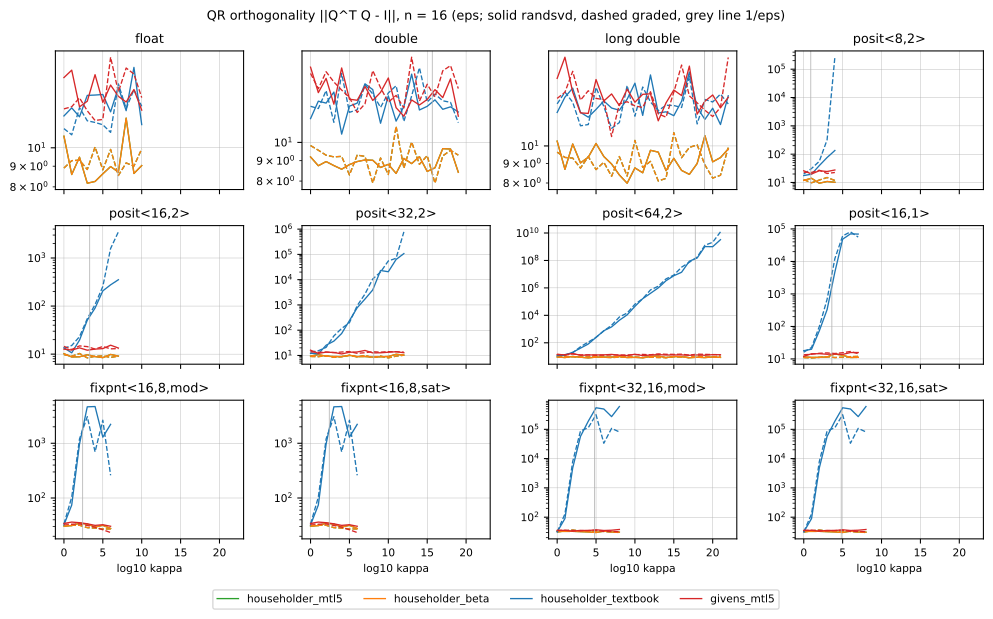
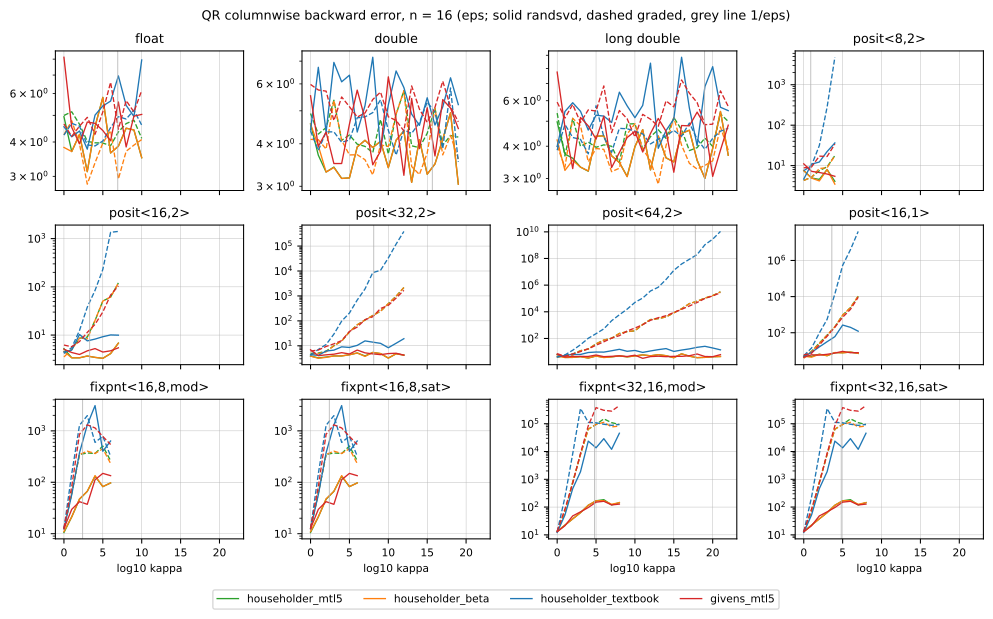
Section titled “IEEE: what the textbooks predict”Every method is backward stable at every κ. At n = 16, the worst columnwise
backward error is 5.5 to 8.8 ε, and the orthogonality of Q is 11 to 17 ε.
Householder with dlarfg’s sign is the tightest of the four, and the textbook
reflector and Givens follow within a factor of two.
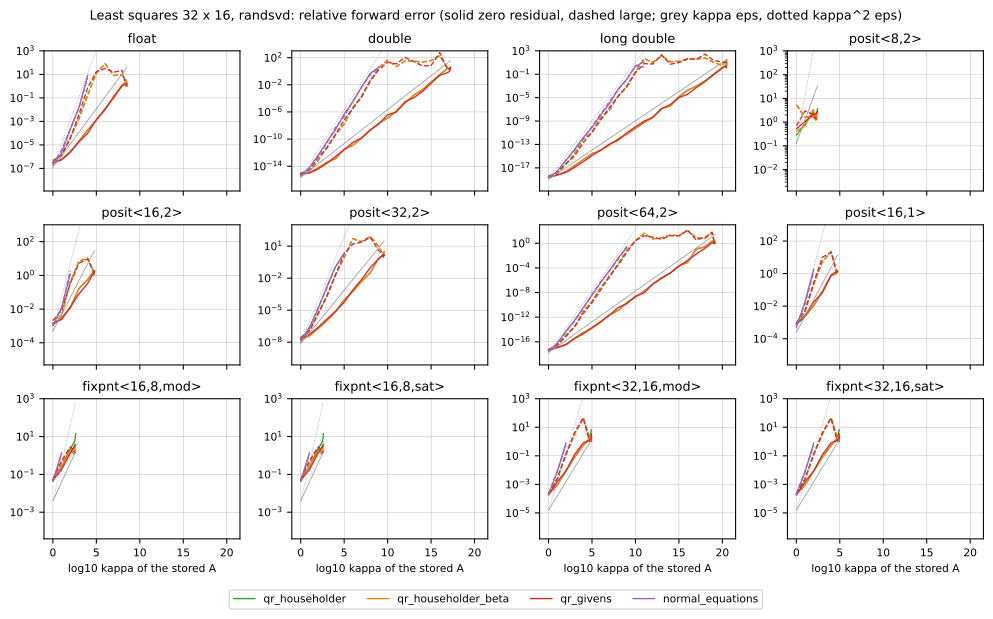
Least squares then splits on the method:
- Zero residual:
- QR stays accurate to about κ ≈ 1/ε: 10¹⁵ in double, 10¹⁹ in long double, at 32 × 16.
- The normal equations stop at about √(1/ε) (10⁷ in double), because forming AᵀA squares κ. Past that, Cholesky breaks down.
- 45° residual: every method stops near √(1/ε), QR included (10⁸ in double). QR’s error has a κ²ε·tan θ term of its own, so with a large residual the orthogonal method buys almost nothing over the normal equations. This is the classical result (Golub & Van Loan §5.3.8), reproduced in each type.
Posits: normwise stable, but not columnwise on graded columns
Section titled “Posits: normwise stable, but not columnwise on graded columns”On randsvd matrices, QR in posits behaves like IEEE. In posit<16,2> through
posit<64,2>, householder_mtl5 and givens_mtl5 stay within about 7 ε columnwise
and 17 ε in orthogonality at every κ.
On graded matrices, where the columns span 1 down to 1/κ, the columnwise backward error grows with κ in every posit. Orthogonality is unaffected:
posit<64,2>, householder_mtl5, n = 16 | κ = 10⁴ | 10⁸ | 10¹² | 10¹⁶ | 10²⁰ |
|---|---|---|---|---|---|
| columnwise backward error | 16 ε | 237 ε | 2.6×10³ ε | 1.7×10⁴ ε | 1.6×10⁵ ε |
| (double at the same κ) | 4.1 ε | 3.8 ε | 5.7 ε | 5.1 ε |
- Rate: the error grows by about 10× every four decades of κ, which is κ^(1/4). That is a posit’s taper. With es = 2, a posit loses one fraction bit for every factor of 16 its magnitude moves away from 1, which is 3.3 bits per factor of 10⁴. A column of size 1/κ is held to fewer bits than ε counts, and its backward error grows to match.
- Normwise: the backward error on the same matrices is 3.1 ε. The loss is confined to the small columns, which a normwise measure weighs by their size.
- Givens shows the same growth (2.7×10⁵ ε at 10²⁰). This is the type, not the method.
So in a posit, Householder QR keeps its normwise guarantee but not the columnwise one that IEEE gives it. The columnwise guarantee is the one that makes it insensitive to column scaling. If an application’s columns differ greatly in scale, equilibrating them before factoring keeps the posit near 1, where it has its bits.
The textbook reflector loses orthogonality in tapered types
Section titled “The textbook reflector loses orthogonality in tapered types”householder_textbook forms v = x − αe₁ and vᵀv unscaled. In posits that costs
orthogonality even on well-conditioned randsvd matrices: 353 ε in posit<16,2>,
1.1×10⁵ ε in posit<32,2>, and 3.3×10⁹ ε in posit<64,2>, where dlarfg’s form
stays at 10 to 11 ε. #13 measured this one reflector at a time. Here it carries
into the factorization: on graded matrices the textbook form’s columnwise error
reaches 1.1×10¹⁰ ε in posit<64,2>. In IEEE the two forms are within a factor of
two.
Fixed point: MTL5’s qr_factor gives exact-zero pivots
Section titled “Fixed point: MTL5’s qr_factor gives exact-zero pivots”In fixpnt<16,8> and fixpnt<32,16>, qr_solve after qr_factor divides by
zero, while the same problems with β stored, or by Givens, never do:
| type | qr_householder | qr_householder_beta | qr_givens |
|---|---|---|---|
| fixpnt<16,8> | 72 of 404 problems | 0 | 0 |
| fixpnt<32,16> | 12 of 558 problems | 0 | 0 |
The cause is in qr_factor. It applies column j’s reflector to column j as
well, so R(j,j) is recomputed as x₀ − τ(vᵀx) instead of being set to the β the
reflector was built for. LAPACK’s dgeqr2 stores β and applies H to columns
j+1 onward only, and so does MTL5’s own textbook path.
- Why fixed point: its resolution is absolute. When a column has shrunk to a few ulps, the products v(i)·x(i) round to 0, so x₀ − τ(vᵀx) is 0 although β = ‖x‖ is representable.
- Minimal case: x = (0, u, u, u, u) with u = 2⁻⁸ gives R(0,0) = 0, where
β = −2u (
test_householder_qr). - In floating point the recomputation only adds rounding.
- What storing β changes:
householder_betaandqr_householder_betastore it. That removes every zero pivot, and where fixed point gives a usable answer at all, it changes nothing material. Filed as mtl5#678.
Universal’s fixpnt hides the symptom by default. A division by zero prints
fixpnt_divide_by_zero and returns maxpos (saturating) or 0 (modulo). In this
study’s first run that showed up as a forward error of 426 that looked like a
result. The study defines FIXPNT_THROW_ARITHMETIC_EXCEPTION to count such
cases instead. Integer, einteger, erational and edecimal share the default;
filed as universal#1894.
Apart from the zero pivots, fixed point is limited by its absolute resolution, not by the method:
- Reach of QR least squares: κ ≈ 1 in fixpnt<16,8> and about 10² to 10³ in fixpnt<32,16>.
- Rank: the graded and Kahan matrices often lose rank outright when rounded
in. Their small entries fall below resolution, and
kappa_storedturns infinite. - Modulo and saturating give identical QR results, and identical least-squares results except in three fixpnt<16,8> rows with a 45° residual. There the forward error is already above 1, an intermediate leaves the range, and wrapping and saturating part ways. Every other failure is at the bottom of the range.
Householder against Givens
Section titled “Householder against Givens”Neither method dominates. In most types their least-squares reach (randsvd) is within a decade of each other. These differ by two decades or more:
- float: Givens reaches 10⁵, against Householder’s 10⁷, at both sizes.
- posit<16,2> at 16 × 8: Givens reaches 10³ and Householder 10. At 32 × 16 the gap is one decade.
- posit<16,1> at 16 × 8: the reverse: Householder reaches 10³ and Givens 10.
- fixpnt<32,16> at 32 × 16: Householder reaches 10³ and Givens 10.
With eight samples per point, one bad sample decides a type’s reach, so differences of a decade are within the noise. The two 16-bit posits pointing opposite ways at the same size suggests the same for some of these. Part 5 tests Givens where it should win: banded and sparse inputs, whose zeros it keeps.
Rounding into the type changes the problem
Section titled “Rounding into the type changes the problem”The Hilbert and Kahan rows show how much the stored matrix differs from the qd one:
| matrix | κ in qd | κ stored in posit<16,2> | in fixpnt<16,8> |
|---|---|---|---|
| Hilbert 16 × 8 | 6.5×10⁸ | 8×10⁴ | 7.2×10² |
| Kahan 16 × 8, θ = 0.2 | 1.6×10⁷ | 5×10⁴ | singular |
A narrow type can’t hold an ill-conditioned matrix at all. What it factors is a better-conditioned neighbour, or a singular one. That is why every least-squares error here is measured against the stored problem, and why the tables give its κ.
Figures
Section titled “Figures”figures/qr_backward_n16.svg: columnwise backward error against κ, one panel per type, randsvd solid and graded dashed.figures/qr_orthogonality_n16.svg: ‖QᵀQ − I‖ against κ, likewise.figures/lstsq_forward_32x16.svg: least-squares forward error against the stored κ, zero residual solid and 45° dashed, with κε and κ²ε as guides.
Tables
Section titled “Tables”Generated by summarize.py from the committed results. A least-squares
“reach” is the largest stored κ up to which every sample’s forward error is at
most 10%, scanning up from κ = 1. A type that is never that accurate shows
none.
QR, n = 8: worst columnwise backward error / orthogonality (eps)
Section titled “QR, n = 8: worst columnwise backward error / orthogonality (eps)”| type | householder_mtl5 | householder_beta | householder_textbook | givens_mtl5 |
|---|---|---|---|---|
| float | 5.05 / 6.94 | 3.94 / 6.94 | 6.17 / 8.59 | 4.93 / 9.02 |
| double | 4.39 / 7.66 | 4.39 / 7.66 | 7.33 / 9.09 | 4.52 / 9.97 |
| long double | 4.78 / 7.09 | 4.78 / 7.09 | 6.62 / 9.42 | 4.45 / 9.76 |
| posit<8,2> | 9.94 / 8.34 | 9.94 / 8.34 | 321 / 3.78e+03 | 13.1 / 12 |
| posit<16,2> | 68.4 / 7.52 | 68.4 / 7.52 | 798 / 641 | 60.5 / 8.95 |
| posit<32,2> | 1.7e+03 / 7.36 | 1.7e+03 / 7.36 | 1.9e+05 / 9.4e+04 | 1.45e+03 / 10.2 |
| posit<64,2> | 2.0e+05 / 8 | 2.0e+05 / 8 | 4.7e+09 / 1.6e+09 | 1.8e+05 / 9.85 |
| posit<16,1> | 4.79e+03 / 8.38 | 4.79e+03 / 8.38 | 7.4e+07 / 7.5e+04 | 4.18e+03 / 9.21 |
| fixpnt<16,8,mod> | 341 / 16.9 | 341 / 16.9 | 627 / 2.28e+03 | 440 / 14.3 |
| fixpnt<16,8,sat> | 341 / 16.9 | 341 / 16.9 | 627 / 2.28e+03 | 440 / 14.3 |
| fixpnt<32,16,mod> | 8.4e+04 / 14.5 | 8.4e+04 / 14.5 | 1.3e+05 / 3.2e+05 | 1.7e+05 / 14.1 |
| fixpnt<32,16,sat> | 8.4e+04 / 14.5 | 8.4e+04 / 14.5 | 1.3e+05 / 3.2e+05 | 1.7e+05 / 14.1 |
QR, n = 16: worst columnwise backward error / orthogonality (eps)
Section titled “QR, n = 16: worst columnwise backward error / orthogonality (eps)”| type | householder_mtl5 | householder_beta | householder_textbook | givens_mtl5 |
|---|---|---|---|---|
| float | 5.81 / 11.8 | 5.81 / 11.8 | 7.94 / 15.8 | 8.13 / 16.8 |
| double | 5.73 / 11 | 5.73 / 11 | 7.19 / 15.4 | 6.29 / 16.3 |
| long double | 5.45 / 10.8 | 5.45 / 10.8 | 8.84 / 15.6 | 7.75 / 17.1 |
| posit<8,2> | 17.7 / 15 | 17.7 / 15 | 4.79e+03 / 2.6e+05 | 33.9 / 27.6 |
| posit<16,2> | 121 / 10.3 | 121 / 10.3 | 1.41e+03 / 3.5e+03 | 105 / 15.4 |
| posit<32,2> | 2.17e+03 / 11.1 | 2.17e+03 / 11.1 | 3.9e+05 / 7.8e+05 | 1.68e+03 / 16.2 |
| posit<64,2> | 3.1e+05 / 11.4 | 3.1e+05 / 11.4 | 1.1e+10 / 1.2e+10 | 2.7e+05 / 16.7 |
| posit<16,1> | 1.1e+04 / 14.2 | 1.1e+04 / 14.2 | 4.0e+07 / 8.1e+04 | 9.21e+03 / 17 |
| fixpnt<16,8,mod> | 506 / 34.7 | 448 / 34.7 | 3.1e+03 / 4.69e+03 | 1.31e+03 / 36.3 |
| fixpnt<16,8,sat> | 506 / 34.7 | 448 / 34.7 | 3.1e+03 / 4.69e+03 | 1.31e+03 / 36.3 |
| fixpnt<32,16,mod> | 1.5e+05 / 36.2 | 1.1e+05 / 36.2 | 3.5e+05 / 6.0e+05 | 4.5e+05 / 38 |
| fixpnt<32,16,sat> | 1.5e+05 / 36.2 | 1.1e+05 / 36.2 | 3.5e+05 / 6.0e+05 | 4.5e+05 / 38 |
Least squares, 16 x 8, zero residual: largest kappa with forward error <= 10%
Section titled “Least squares, 16 x 8, zero residual: largest kappa with forward error <= 10%”| type | 1/eps | qr_householder | qr_householder_beta | qr_givens | normal_equations |
|---|---|---|---|---|---|
| float | 8.4e+06 | 1e7 | 1e7 | 1e5 | 1e3 |
| double | 4.5e+15 | 1e14 | 1e14 | 1e14 | 1e7 |
| long double | 9.2e+18 | 1e18 | 1e18 | 1e17 | 1e9 |
| posit<8,2> | 8.0e+00 | none | none | none | none |
| posit<16,2> | 2.0e+03 | 1e1 | 1e1 | 1e3 | 10 |
| posit<32,2> | 1.3e+08 | 1e8 | 1e8 | 1e7 | 1e3 |
| posit<64,2> | 5.8e+17 | 1e17 | 1e17 | 1e17 | 1e8 |
| posit<16,1> | 4.1e+03 | 1e3 | 1e3 | 1e1 | 1e1 |
| fixpnt<16,8,mod> | 2.6e+02 | 1.01 | 1.01 | 1.01 | 1.01 |
| fixpnt<16,8,sat> | 2.6e+02 | 1.01 | 1.01 | 1.01 | 1.01 |
| fixpnt<32,16,mod> | 6.6e+04 | 1e2 | 1e2 | 1e2 | 1e1 |
| fixpnt<32,16,sat> | 6.6e+04 | 1e2 | 1e2 | 1e2 | 1e1 |
Least squares, 16 x 8, large residual: largest kappa with forward error <= 10%
Section titled “Least squares, 16 x 8, large residual: largest kappa with forward error <= 10%”| type | 1/eps | qr_householder | qr_householder_beta | qr_givens | normal_equations |
|---|---|---|---|---|---|
| float | 8.4e+06 | 1e3 | 1e3 | 1e3 | 1e3 |
| double | 4.5e+15 | 1e8 | 1e8 | 1e8 | 1e7 |
| long double | 9.2e+18 | 1e9 | 1e9 | 1e9 | 1e9 |
| posit<8,2> | 8.0e+00 | none | none | none | none |
| posit<16,2> | 2.0e+03 | 10 | 10 | 10 | 10 |
| posit<32,2> | 1.3e+08 | 1e4 | 1e4 | 1e4 | 1e3 |
| posit<64,2> | 5.8e+17 | 1e9 | 1e9 | 1e9 | 1e8 |
| posit<16,1> | 4.1e+03 | 1e1 | 1e1 | 1e1 | 1e1 |
| fixpnt<16,8,mod> | 2.6e+02 | 1.01 | 1.01 | 1.01 | 1.01 |
| fixpnt<16,8,sat> | 2.6e+02 | 1.01 | 1.01 | 1.01 | 1.01 |
| fixpnt<32,16,mod> | 6.6e+04 | 1e1 | 1e1 | 1e1 | 1e1 |
| fixpnt<32,16,sat> | 6.6e+04 | 1e1 | 1e1 | 1e1 | 1e1 |
Least squares, 16 x 8, hilbert: forward error
Section titled “Least squares, 16 x 8, hilbert: forward error”| type | kappa stored | qr_householder | qr_householder_beta | qr_givens | normal_equations |
|---|---|---|---|---|---|
| float | 3.9e+08 | 0.67 | 0.67 | 2 | 1 breakdown |
| double | 6.5e+08 | 2.5e-09 | 2.5e-09 | 6.8e-09 | 1 breakdown |
| long double | 6.5e+08 | 1.4e-12 | 1.4e-12 | 4.4e-12 | 0.0099 |
| posit<8,2> | 3.4e+02 | 0.59 | 0.71 | 1.6 | 1 breakdown |
| posit<16,2> | 8e+04 | 1.3 | 1.3 | 0.76 | 1 breakdown |
| posit<32,2> | 6.6e+08 | 0.14 | 0.14 | 0.0099 | 1 breakdown |
| posit<64,2> | 6.5e+08 | 6e-11 | 6e-11 | 1.2e-10 | 0.17 |
| posit<16,1> | 8e+04 | 0.73 | 0.73 | 1.4 | 1 breakdown |
| fixpnt<16,8,mod> | 7.2e+02 | 1 thrown | 1.9 | 1.8 | 1 breakdown |
| fixpnt<16,8,sat> | 7.2e+02 | 1 thrown | 1.9 | 1.8 | 1 breakdown |
| fixpnt<32,16,mod> | 2.2e+05 | 1.3 | 0.99 | 1.7 | 1 breakdown |
| fixpnt<32,16,sat> | 2.2e+05 | 1.3 | 0.99 | 1.7 | 1 breakdown |
Least squares, 16 x 8, kahan: forward error
Section titled “Least squares, 16 x 8, kahan: forward error”| type | kappa stored | qr_householder | qr_householder_beta | qr_givens | normal_equations |
|---|---|---|---|---|---|
| float | 1.6e+07 | 0.22 | 0.22 | 0.24 | 8 breakdown |
| double | 1.6e+07 | 2.7e-10 | 2.7e-10 | 4.6e-10 | 0.0088 |
| long double | 1.6e+07 | 2.9e-13 | 2.9e-13 | 2.8e-13 | 8e-06 |
| posit<8,2> | 8.4e+65 | singular | singular | singular | singular |
| posit<16,2> | 5e+04 | 3.9 | 3.9 | 1.4 | 8 breakdown |
| posit<32,2> | 1.6e+07 | 0.0025 | 0.0025 | 0.017 | 5 breakdown |
| posit<64,2> | 1.6e+07 | 1.7e-12 | 1.7e-12 | 3.9e-12 | 6.9e-05 |
| posit<16,1> | 7.7e+04 | 1.7 | 1.7 | 1.4 | 8 breakdown |
| fixpnt<16,8,mod> | 6.9e+65 | singular | singular | singular | singular |
| fixpnt<16,8,sat> | 6.9e+65 | singular | singular | singular | singular |
| fixpnt<32,16,mod> | 2.3e+05 | 2 | 1.9 | 1.9 | 8 breakdown |
| fixpnt<32,16,sat> | 2.3e+05 | 2 | 1.9 | 1.9 | 8 breakdown |
Least squares, 32 x 16, zero residual: largest kappa with forward error <= 10%
Section titled “Least squares, 32 x 16, zero residual: largest kappa with forward error <= 10%”| type | 1/eps | qr_householder | qr_householder_beta | qr_givens | normal_equations |
|---|---|---|---|---|---|
| float | 8.4e+06 | 1e7 | 1e7 | 1e5 | 1e3 |
| double | 4.5e+15 | 1e15 | 1e15 | 1e15 | 1e7 |
| long double | 9.2e+18 | 1e19 | 1e19 | 1e18 | 1e9 |
| posit<8,2> | 8.0e+00 | none | none | none | none |
| posit<16,2> | 2.0e+03 | 1e2 | 1e2 | 1e3 | 10 |
| posit<32,2> | 1.3e+08 | 1e8 | 1e8 | 1e8 | 1e3 |
| posit<64,2> | 5.8e+17 | 1e16 | 1e16 | 1e17 | 1e8 |
| posit<16,1> | 4.1e+03 | 1e3 | 1e3 | 1e3 | 10 |
| fixpnt<16,8,mod> | 2.6e+02 | 1.01 | 1.01 | 1.01 | 1.01 |
| fixpnt<16,8,sat> | 2.6e+02 | 1.01 | 1.01 | 1.01 | 1.01 |
| fixpnt<32,16,mod> | 6.6e+04 | 1e3 | 1e3 | 1e1 | 1e1 |
| fixpnt<32,16,sat> | 6.6e+04 | 1e3 | 1e3 | 1e1 | 1e1 |
Least squares, 32 x 16, large residual: largest kappa with forward error <= 10%
Section titled “Least squares, 32 x 16, large residual: largest kappa with forward error <= 10%”| type | 1/eps | qr_householder | qr_householder_beta | qr_givens | normal_equations |
|---|---|---|---|---|---|
| float | 8.4e+06 | 1e3 | 1e3 | 1e3 | 1e3 |
| double | 4.5e+15 | 1e8 | 1e8 | 1e8 | 1e7 |
| long double | 9.2e+18 | 1e9 | 1e9 | 1e9 | 1e9 |
| posit<8,2> | 8.0e+00 | none | none | none | none |
| posit<16,2> | 2.0e+03 | 10 | 10 | 10 | 10 |
| posit<32,2> | 1.3e+08 | 1e4 | 1e4 | 1e4 | 1e3 |
| posit<64,2> | 5.8e+17 | 1e9 | 1e9 | 1e9 | 1e8 |
| posit<16,1> | 4.1e+03 | 10 | 10 | 10 | 10 |
| fixpnt<16,8,mod> | 2.6e+02 | 1.01 | 1.01 | 1.01 | 1.01 |
| fixpnt<16,8,sat> | 2.6e+02 | 1.01 | 1.01 | 1.01 | 1.01 |
| fixpnt<32,16,mod> | 6.6e+04 | 1e1 | 1e1 | 1e1 | 1e1 |
| fixpnt<32,16,sat> | 6.6e+04 | 1e1 | 1e1 | 1e1 | 1e1 |
Least squares, 32 x 16, hilbert: forward error
Section titled “Least squares, 32 x 16, hilbert: forward error”| type | kappa stored | qr_householder | qr_householder_beta | qr_givens | normal_equations |
|---|---|---|---|---|---|
| float | 8.1e+08 | 0.7 | 0.7 | 1.4 | 1 breakdown |
| double | 2.4e+17 | 0.47 | 0.47 | 0.3 | 1 breakdown |
| long double | 1.6e+19 | 0.029 | 0.029 | 0.056 | 1 breakdown |
| posit<8,2> | 4e+02 | 6.7 | 2.2 | 2.7 | 1 breakdown |
| posit<16,2> | 7.6e+04 | 1.3 | 1.3 | 1.5 | 1 breakdown |
| posit<32,2> | 4.6e+09 | 0.63 | 0.63 | 0.35 | 1 breakdown |
| posit<64,2> | 8.9e+18 | 0.036 | 0.036 | 0.23 | 1 breakdown |
| posit<16,1> | 7.6e+04 | 0.61 | 0.65 | 1.2 | 1 breakdown |
| fixpnt<16,8,mod> | 6.5e+02 | 1 thrown | 2.6 | 2.5 | 1 breakdown |
| fixpnt<16,8,sat> | 6.5e+02 | 1 thrown | 2.6 | 2.5 | 1 breakdown |
| fixpnt<32,16,mod> | 1.5e+05 | 1.5 | 1.2 | 2 | 1 breakdown |
| fixpnt<32,16,sat> | 1.5e+05 | 1.5 | 1.2 | 2 | 1 breakdown |
Least squares, 32 x 16, kahan: forward error
Section titled “Least squares, 32 x 16, kahan: forward error”| type | kappa stored | qr_householder | qr_householder_beta | qr_givens | normal_equations |
|---|---|---|---|---|---|
| float | 8.3e+65 | singular | singular | singular | singular |
| double | 2.2e+15 | 0.041 | 0.041 | 0.06 | 8 breakdown |
| long double | 2.2e+15 | 1.1e-05 | 1.1e-05 | 1.9e-05 | 6 breakdown |
| posit<8,2> | 2.4e+66 | singular | singular | singular | singular |
| posit<16,2> | 1.6e+66 | singular | singular | singular | singular |
| posit<32,2> | 8.6e+09 | 1 non-finite | 1 non-finite | 5.4e+04 | 8 breakdown |
| posit<64,2> | 2.2e+15 | 0.00029 | 0.00029 | 0.00032 | 8 breakdown |
| posit<16,1> | 1.7e+66 | singular | singular | singular | singular |
| fixpnt<16,8,mod> | 2e+66 | singular | singular | singular | singular |
| fixpnt<16,8,sat> | 2e+66 | singular | singular | singular | singular |
| fixpnt<32,16,mod> | 1.6e+66 | singular | singular | singular | singular |
| fixpnt<32,16,sat> | 1.6e+66 | singular | singular | singular | singular |