Givens rotations and Householder reflectors, one at a time
mp-numerics#13, part of the series in stillwater-sc/mtl5#666. This study measures
how a single plane rotation or a single Householder reflector behaves in each
number system, before any factorization is built on them. It tests MTL5’s own
kernels, mtl::apply_givens_rotation (operation/givens.hpp) and
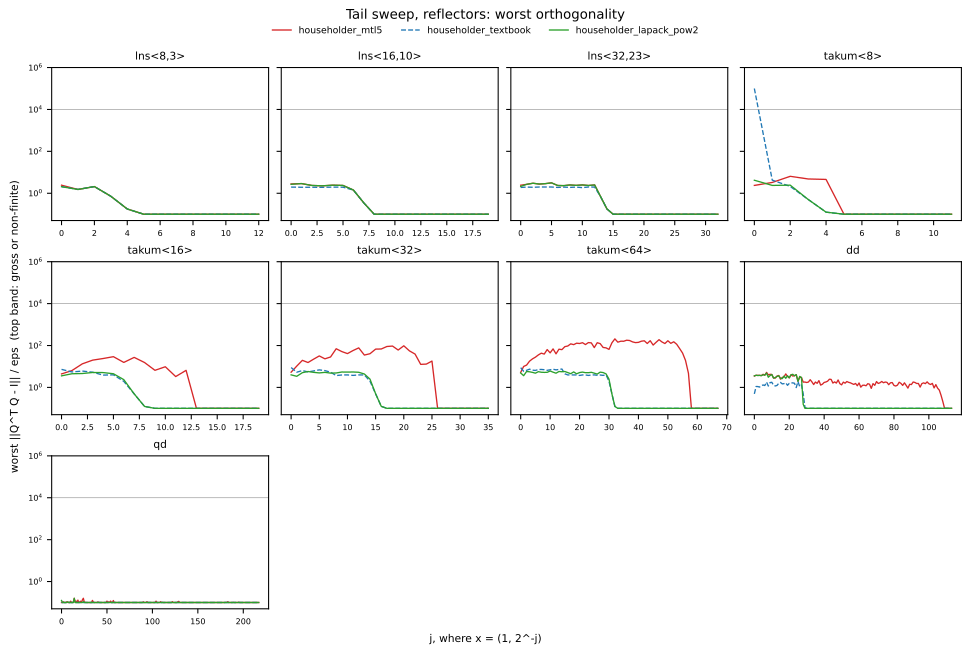
mtl::householder (operation/householder.hpp), against the forms LAPACK uses
and against two power-of-two-scaled forms written here.
It covers 65 types: the hardware IEEE types, posits, fixed point, the cfloat matrix from FP8 to 256 bits in three variants, lns, linear takums, and double-double and quad-double.
Running it
Section titled “Running it”cmake --build build --target givens_householder_study./build/benchmarks/linalg/givens_householder/givens_householder_study results/python3 benchmarks/linalg/givens_householder/summarize.py results/python3 benchmarks/linalg/givens_householder/plot.py results/ figures/--quick runs a small sample, and --family ieee,posit,fixpnt,cfloat,lns,takum,dd,qd
picks families (all by default). The full run takes about four minutes against
MTL5 5.21.0, most of it in the wide cfloats. Against 5.22.0 it takes over two
hours: givens_mtl5 and householder_mtl5 then go through MTL5’s
pow2_scaling, whose exponent search costs one multiplication per binade
(mtl5#680). MTL5 main fixes
that (mtl5#681), and the run
takes about four minutes again. Each CSV has a .sysinfo sidecar recording the
platform, compiler, sample counts and the commits of mp-numerics, MTL5 and
Universal. The commits are read when CMake configures, so reconfigure before a
run whose results are kept; +dirty marks uncommitted changes. The inputs come
from std::mt19937_64 and std::cos/std::sin, so another platform’s libm can
move an input by an ulp and change the last digits. The committed results are
byte-identical between GCC 15 and Clang 21 on x86-64. plot.py needs
matplotlib; summarize.py needs only the standard library.
A default configure measures whatever MTL5 and Universal it gets: an installed
MTL5 of at least 5.22 and an installed Universal through find_package, or
otherwise both fetched from main. To reproduce a recorded run, check out the
three commits in its .sysinfo and point CMake at the checkouts:
cmake -S . -B build -DCMAKE_BUILD_TYPE=Release \ -DCMAKE_DISABLE_FIND_PACKAGE_MTL5=ON -DCMAKE_DISABLE_FIND_PACKAGE_universal=ON \ -DFETCHCONTENT_SOURCE_DIR_MTL5=/path/to/mtl5 \ -DFETCHCONTENT_SOURCE_DIR_UNIVERSAL=/path/to/universalThe two DISABLE flags keep an installed copy from taking precedence over the
checkouts. The runs this README reports:
| run | mp-numerics | MTL5 | Universal |
|---|---|---|---|
| committed results (5.21.0) | d29d67d | d442189: v5.21.0’s headers | 2d5c785 |
| rerun against 5.22.0 | 7fedb19 | cf2f8a5: v5.22.0’s headers | 85172d9 |
| rerun against main | 92e26d0 | 8b31047 | 85172d9 |
What is measured
Section titled “What is measured”Each operator is built for x = (a, b) and measured exactly. The computed values
are read out of the number type as exact Shewchuk expansions
(include/sw/mp_numerics/exact.hpp), so every error below is the error of the
operator the arithmetic produced, rounded once to double for the CSV. Values
beyond double’s range are first scaled by a power of two inside the type, which
is exact. lns values are not dyadic and are read through double, which rounds
far below lns<32,23>‘s own resolution.
| column | meaning |
|---|---|
orth | ‖QᵀQ − I‖₂ of the computed operator: |c² + s² − 1| for a rotation, |g|·|g − 2| with g = τ vᵀv for a reflector |
r_err | |stored entry − ‖x‖| / ‖x‖, for the value a factorization keeps in place of a (r, or the first entry of H x) |
annih | |second entry of Q x| / ‖x‖, with Q applied exactly |
annih_fp | the same entry computed in the type |
nonfinite | samples with an infinity or NaN in the operator or its result |
identity | samples where the routine returned the identity |
gross | samples with orth or annih above max(1/2, 16 eps): the operator is wrong beyond what rounding explains. The 16 eps floor matters only for the 8-bit types. A computed value that, scaled like its data, falls outside double’s range cannot be read; it is finite, so it counts as gross, not as nonfinite: it is off by a factor near 2^1000. r_err is left out, because at the ends of a tapered or fixed-point range it mostly measures how coarsely the type represents ‖x‖ |
eps is std::numeric_limits<T>::epsilon(), the spacing at 1, and the tables
give errors in units of it. Two cautions in reading them. A tapered type
(posit, takum) is coarser below 1 than at 1, so rounding alone can cost a few
eps. And dd and qd carry a bit or three more than their epsilon() (2^-105 and
2^-209) suggests, so their errors can fall below 1 eps.
The operators
Section titled “The operators”| name | what it is |
|---|---|
givens_mtl5 | mtl::apply_givens_rotation: r = sqrt(a·a + b·b), c = a/r, s = b/r. GMRES uses it, and MINRES and the symmetric QR iteration use the same formula |
givens_max_scaled | divide by m = max(|a|, |b|) first, as LAPACK’s lapy2 does; c = a/r |
givens_safe_scaled | Anderson’s safe scaling, transcribed from Reference-LAPACK dlartg.f90 (3.10), its thresholds taken from std::numeric_limits |
givens_pow2_scaled | scale by an exact 2^-e with 2^e ≤ max(|a|, |b|), so the squares sit near 1; c and s from the scaled values |
householder_mtl5 | mtl::householder: max-scaled, Parlett’s sign (onto +‖x‖e₁ for x₀ > 0), v(0) = 1, applied as qr_solve applies it |
householder_textbook | mtl::householder(x, tag::textbook_reflector): v = x − αe₁ with α = −sign(x₀)‖x‖, unscaled, unnormalized |
householder_lapack_pow2 | dlarfg’s sign (onto −sign(x₀)‖x‖e₁) and v(0) = 1, on x scaled by an exact 2^-e |
givens_mtl5 and householder_mtl5 describe MTL5 5.21.0, which the committed
results measured. MTL5 5.22.0 adopted the two remedies below, so a rerun
against it measures givens_mtl5 as the power-of-two scaled rotation and
householder_mtl5 as the dlarfg-signed, power-of-two scaled reflector. How
closely they reproduce givens_pow2_scaled and householder_lapack_pow2 is in
Rerun against MTL5 5.22.0, and after the fix for
the failures found there, in Rerun against MTL5 main.
The inputs
Section titled “The inputs”| input | x | per row |
|---|---|---|
base | random directions, ‖x‖ = 1 | 10000 samples |
scale | random directions, ‖x‖ = 2^k for k across the type’s whole range (param = k) | 32 samples |
tail | (±1, ±2^-j (1 + u)), j from 0 to 8 past the type’s precision (param = j) | 32 samples |
repeat | power: one operator applied k times to 16 unit vectors (dev = max | ‖y‖ − ‖y₀‖ | / ‖y₀‖, against the start vector as rounded into the type); product: k fresh operators accumulated into an 8 × 8 Q (dev = ‖QᵀQ − I‖_F) | 8 and 4 trials |
The types
Section titled “The types”| family | types |
|---|---|
| ieee | float, double, long double (x87 80-bit here; the bits column records which one ran) |
| posit | posit<8,2>, <16,2>, <32,2>, <64,2>, and posit<16,1> |
| fixpnt | fixpnt<16,8> and <32,16>, each wrapping (mod) and saturating (sat) |
| cfloat | cfloat<8,4> (FP8 E4M3) and <8,5> (E5M2), <16,5>, <24,8>, <32,8>, <40,11>, <48,11>, <56,11>, <64,11>, <80,15>, <128,15>, <256,19>; the exponent is IEEE’s where IEEE defines the size, truncated from the next IEEE size otherwise. Each in three variants: IEEE behaviour (gradual underflow, overflow to infinity), nosub (no subnormals) and sat (overflow saturates to max). The three variants of a size see the same inputs |
| lns | lns<8,3>, <16,10>, <32,23>: the ranges of E4M3 (2^±8), binary16 (2^±16) and binary32 (2^±128) |
| takum | linear takum<8>, <16>, <32>, <64>, with the specified three regime bits; range 2^±255 |
| dd, qd | sw::universal::dd and qd: double’s range, two and four times its precision |
test_rotations checks that cfloat<32,8> and cfloat<64,11> give float’s and
double’s measures bit for bit through all seven operators, subnormals to overflow,
so the cfloat rows can be read as the corresponding IEEE type’s would be.
Findings
Section titled “Findings”Findings 1 to 7 come from the first part of the study (IEEE, posit, fixpnt) and hold for the types added since. Findings 8 to 12 are about the added types.
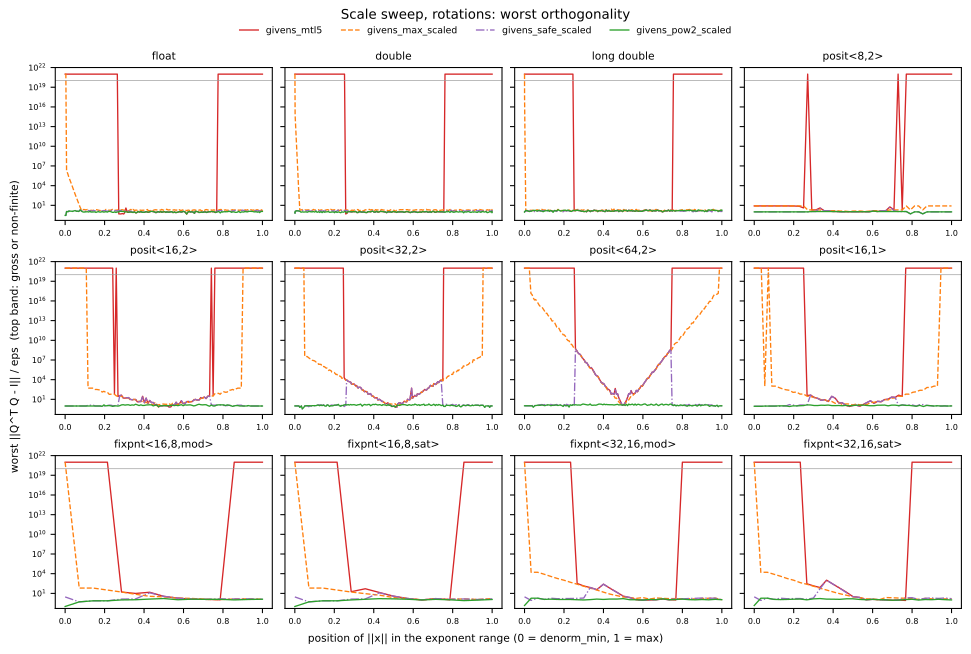
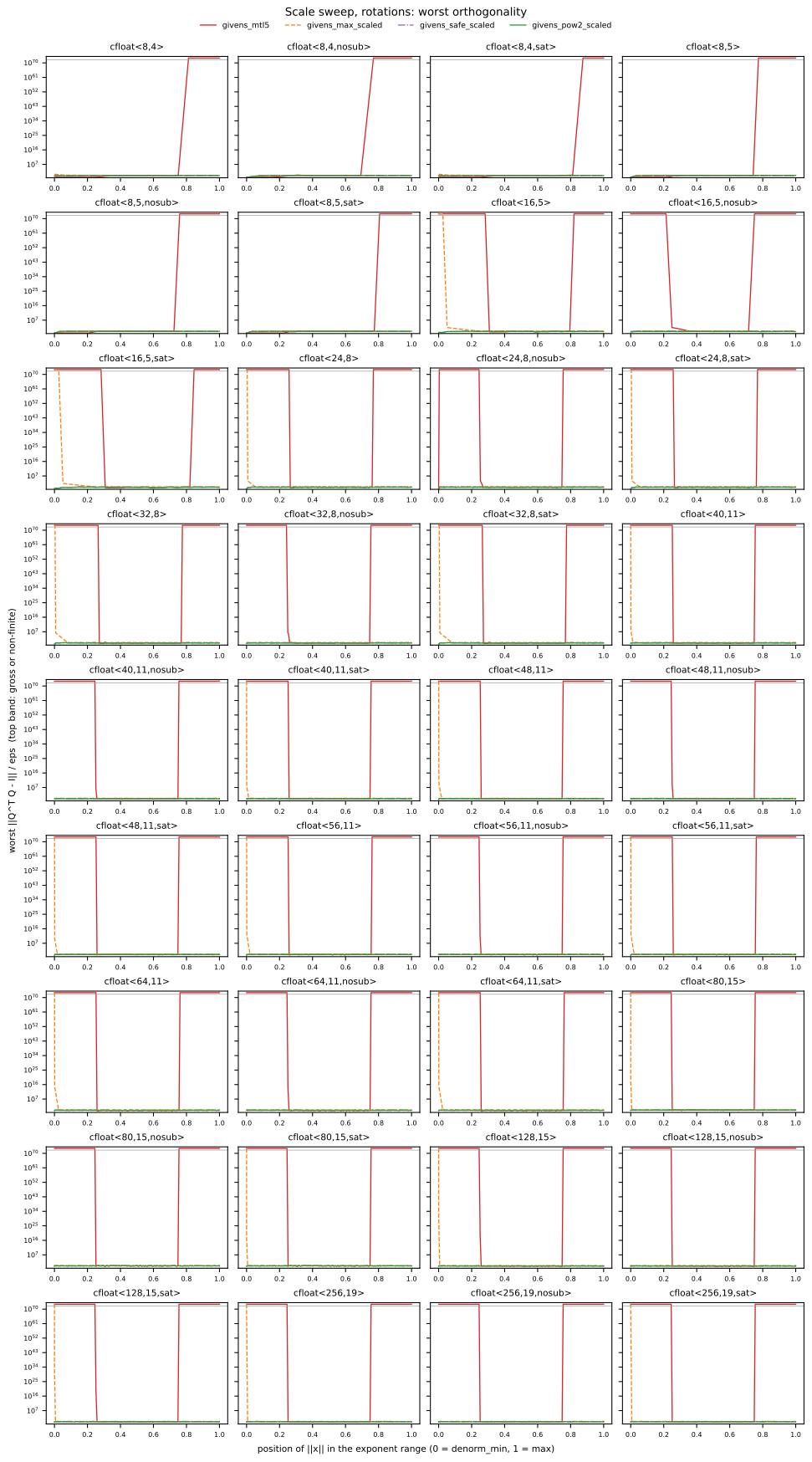
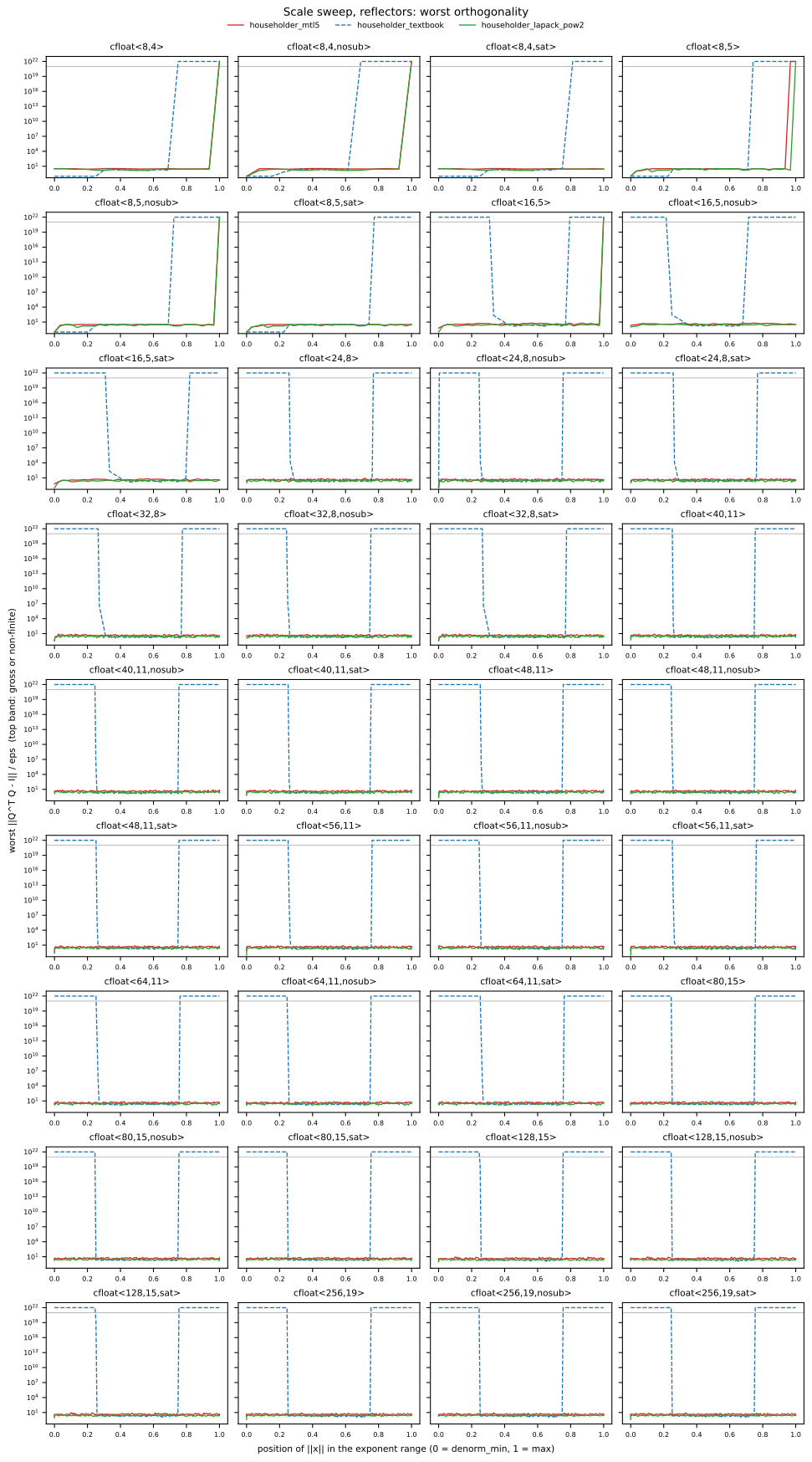
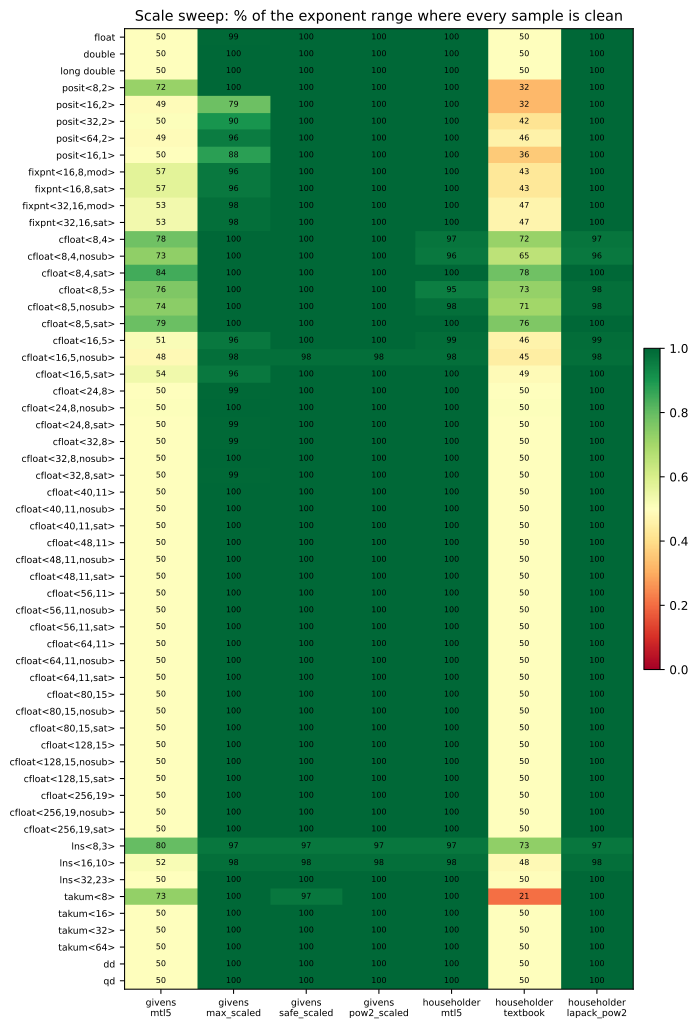
1. MTL5’s rotation fails outside half the exponent range. a·a overflows once |a| passes sqrt(max), and underflows below sqrt(min), long before r would. The clean band is k ∈ [−74, 63] for float out of [−149, 127], and [−533, 509] for double. How it fails depends on the type. In IEEE, r becomes infinite, so c = s = 0 and the rotation is the zero matrix; or r underflows to 0, and the rotation is the identity with r = 0 stored for ‖x‖. In a posit or a saturating fixed-point type, the square saturates and the rotation is finite and wrong. A wrapping fixed-point type wraps. Even inside the band, a posit’s squares land where it has few bits: posit<64,2> reaches 5×10⁸ eps. Every type added since loses the top half of its range the same way, cfloat<256,19> included (clean for k ∈ [−130423, 130188] of [−262378, 262143]). The bottom half fails in the types with IEEE-like underflow. A posit, a takum or an lns rounds a tiny square up to its smallest value instead, so there the rotation stays finite and not gross, only inaccurate (finding 8).
2. lapy2’s scaling stops the overflow, but not the loss of accuracy.
With c = a/r, the error of r at the input’s own magnitude goes into c. That
magnitude is subnormal in IEEE, or far from 1 in a posit, where r has few bits.
The operator is not grossly wrong there, but its orthogonality error reaches
0.25: 1.1×10¹⁵ eps in double near the subnormal range, and 1.4×10¹⁷ eps in
posit<64,2>. The cause is the subnormals: in every cfloat without them the
max-scaled rotation is clean across the whole range, within 2.7 eps.
3. dlartg’s safe scaling guards the range, not the precision. In IEEE
it is what it was designed to be: clean across the whole range, within 2.1 eps,
in every cfloat from 8 to 256 bits too. In a posit it never fails grossly, but
its thresholds come from the range: it scales only when an entry is beyond
sqrt(min) or sqrt(max/2), and inside those bounds a posit’s squares fall where
it has few bits. posit<64,2> reaches 5×10⁸ eps and posit<32,2> 9×10³ eps. The
thresholds would have to come from where the type is precise, not from where it
overflows. Findings 10 and 11 show the same for takum and dd.
4. Scaling by an exact power of two fixes the rotation in every type.
givens_pow2_scaled is clean across the whole range of all 65 types, within
4.6 eps in dd and takum and within 2.2 eps in every other type. The scaling rounds nothing in a
floating-point type and puts the squares near 1.
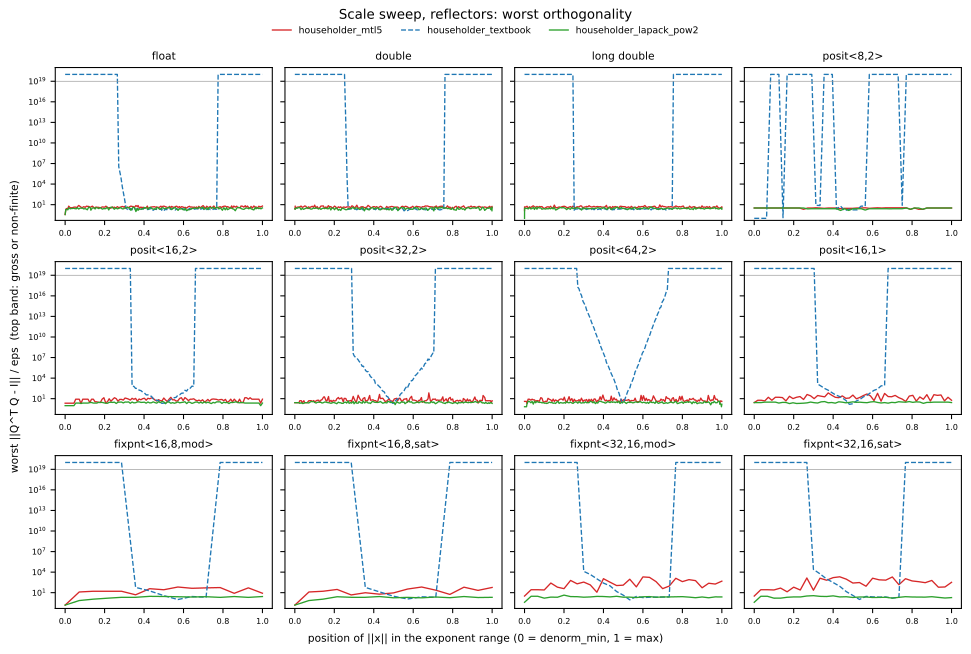
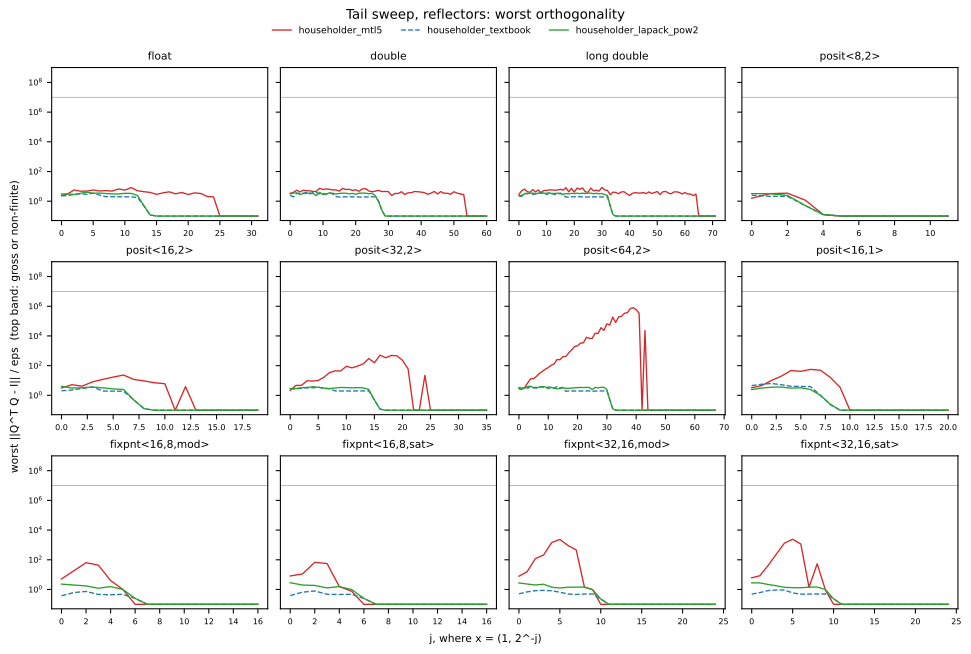
5. MTL5’s reflector loses accuracy on small tails in tapered and
fixed-point types, because of its choice of sign. Parlett’s sign gives
v₀ = −σ/(x₀ + ‖x‖), which is small when the tail is small, so after
normalizing v(0) = 1 the second entry is v₁ ≈ −2x₀/x₁, which is large. In IEEE
that costs nothing (about 9 eps at worst). In a posit, v₁ and 1 + v₁² land where the
posit has few bits: on the tail sweep posit<32,2> reaches 512 eps and
posit<64,2> 8×10⁵ eps; takum<64> reaches 207 eps. In fixed point, which has
absolute precision, the reflector reaches 2.4×10³ eps in fixpnt<32,16>. In the
tail sweep x₀ = ±1, so MTL5’s scaling divides by 1 and rounds nothing: the sign
alone is the cause. With dlarfg’s sign, |v₀| = |x₀| + ‖x‖ ≥ ‖x‖, so every
entry of the normalized v is at most 1, and householder_lapack_pow2 stays
within 8.7 eps for every type, at every scale and every tail (5.4 eps outside
takum). Its only failures are a few non-finite samples in the top binade of
the 8- and 16-bit cfloats with IEEE overflow, where a value the reflector must
form, ‖x‖ or the dot product of its application, overflows the type. MTL5’s identity fallback (mtl5#662) catches the worst cases, but only
once the error exceeds the tail: from j = 8 in posit<16,2> and j = 40 in
posit<64,2>.
6. MTL5’s textbook reflector is accurate but unscaled. It has the LAPACK sign and no normalization, so it is within 6.4 eps on every tail in IEEE, posits and fixed point, and within 1 eps in fixed point. Its unscaled sum of squares limits it to the same half-range band as the unscaled rotation.
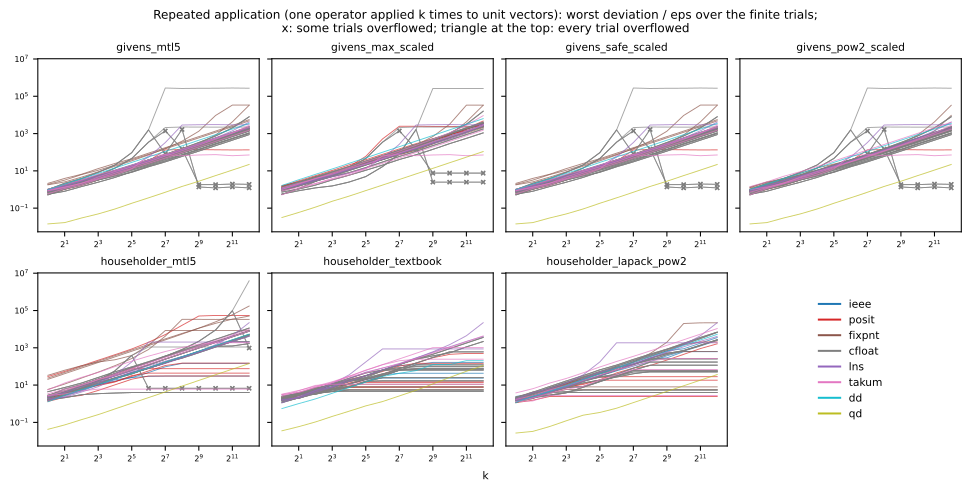
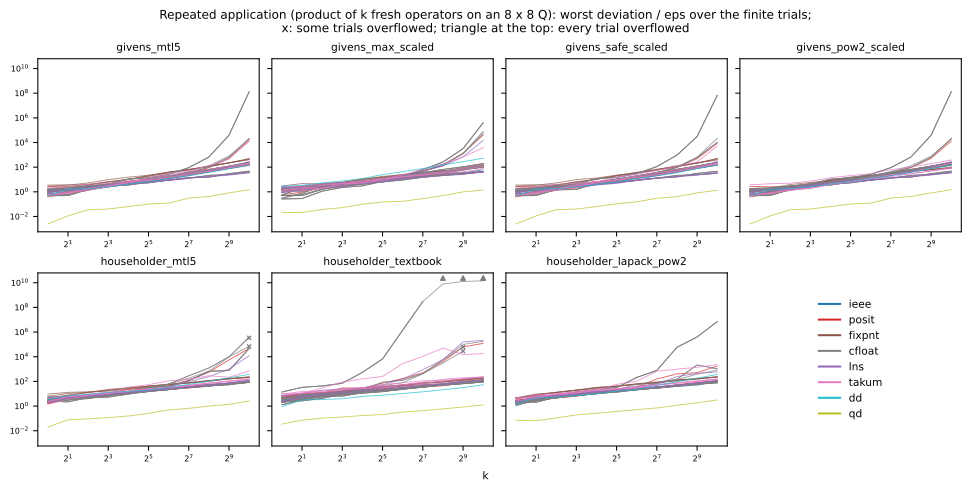
7. Repeated application. One rounded rotation applied k times stretches or shrinks every vector by about k·|c² + s² − 1|/2, so the error grows linearly: 10³ to 10⁴ eps at k = 4096 (880 to 3.4×10⁴) in every type of 16 bits or more, whichever way the rotation was computed; qd, at 22 to 109 eps, holds more bits than its eps counts. A reflector is its own inverse, so applied repeatedly its errors partly cancel, and how much depends on the operator and the type: from 6 to 10⁵ eps, and more where a type saturates (finding 9). Accumulating k fresh operators into an 8 × 8 Q grows far more slowly: 30 to 540 eps at k = 1024 in every type of 16 bits or more. The 8-bit types are too narrow for it: 230 eps at best (takum<8> with power-of-two scaling) and up to 10¹⁰ eps (E5M2).
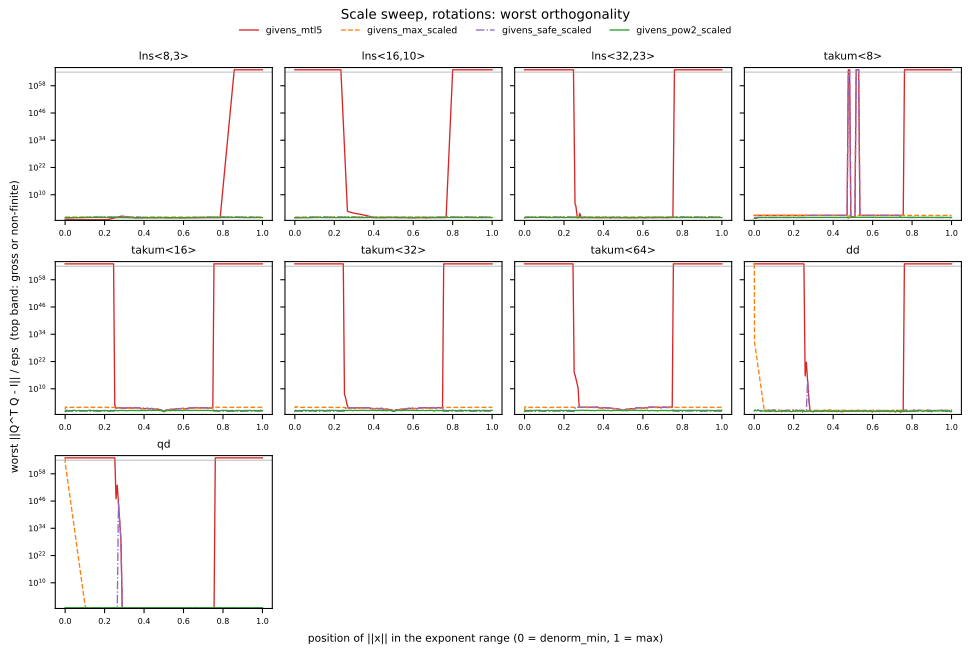
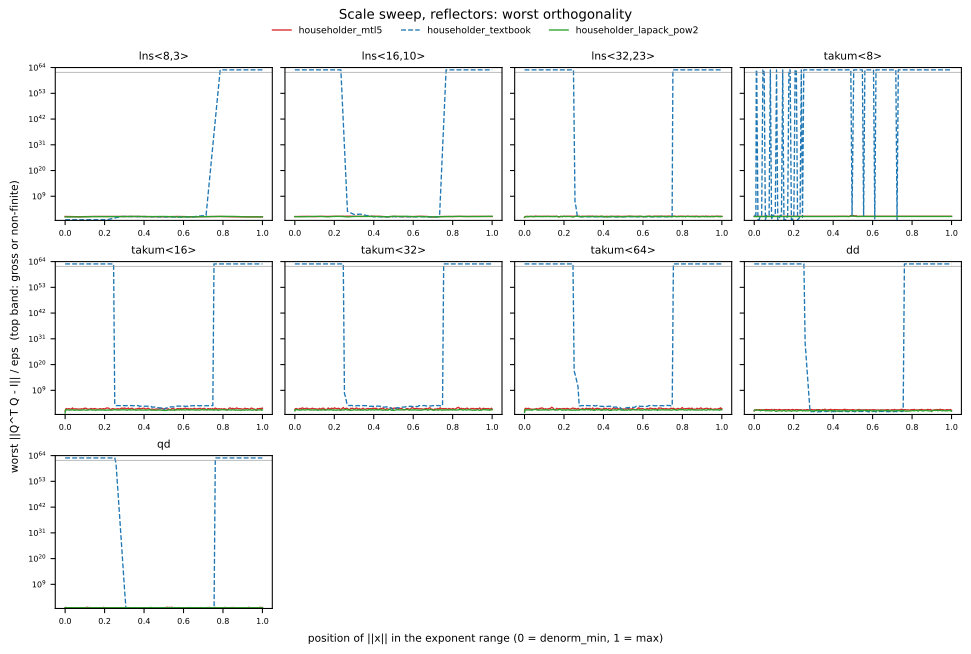
8. Without subnormals, the unscaled forms lose accuracy before they fail. A square below the smallest normal flushes to zero instead of losing bits gradually, so r and c take a relative error up to 1/2 at the bottom of the band while staying under the gross threshold: MTL5’s rotation reaches 6.6×10¹³ eps in cfloat<64,11,nosub> against 1.2 eps in cfloat<64,11>, and 2.7×10⁶ eps in cfloat<32,8,nosub>. lns has no gradual underflow either: a square below its smallest value rounds up to that value, and MTL5’s rotation reaches 5.7×10⁵ eps in lns<32,23> at the bottom of its band. The scaled forms never square a small number and are unaffected.
9. Saturation turns overflow into a large finite error. In the sweeps the saturating cfloats behave as the IEEE ones do: their rows are identical but at the very top of the range, where the norm overflows in IEEE and is clamped here. In repeated application they differ. A rounded rotation that is slightly expansive grows a vector until it overflows: in IEEE FP8, some of the 8 power trials of each rotation end at infinity (1 to 6, depending on the rotation), and are counted as non-finite. With saturation the same trials end clamped at max, and the deviation they report is 2.3×10³ eps in E4M3, 2.7×10⁵ eps in E5M2 and 3.9×10⁶ eps for MTL5’s reflector in cfloat<16,5,sat>: wrong, and nothing in the value says so.
10. Takums behave like posits, but far more gently. Their precision falls
off toward the ends of the range more slowly than a posit’s. dlartg’s
scaling reaches 50 to 95 eps (posit<64,2>: 5×10⁸), lapy2’s 106 to 126 eps
(posit<64,2>: 1.4×10¹⁷), and MTL5’s reflector 30 to 61 eps on the scale sweep
and 207 eps on the tail sweep in takum<64>. The power-of-two forms stay within
3.7 and 7.9 eps. takum<8> is too narrow to say much: at the gross threshold of
2, MTL5’s rotation is clean only from k = −239 to 122.
11. dd and qd hold full precision over less than double’s range. Below
2^-969 the low limb of a dd underflows, so its precision falls toward a
double’s. numeric_limits<dd> reports double’s exponent range all the same,
so dlartg’s thresholds (sqrt(min) ≈ 2^-511) let squares into that zone:
6.5×10¹³ eps in dd, 1.4×10⁴⁵ eps in qd, both near 2^-59 in absolute terms.
MTL5’s rotation reaches 4.7×10²¹ eps in dd inside its band, from k = −494
down. The power-of-two forms keep the squares near 1 and stay within 3.8 eps.
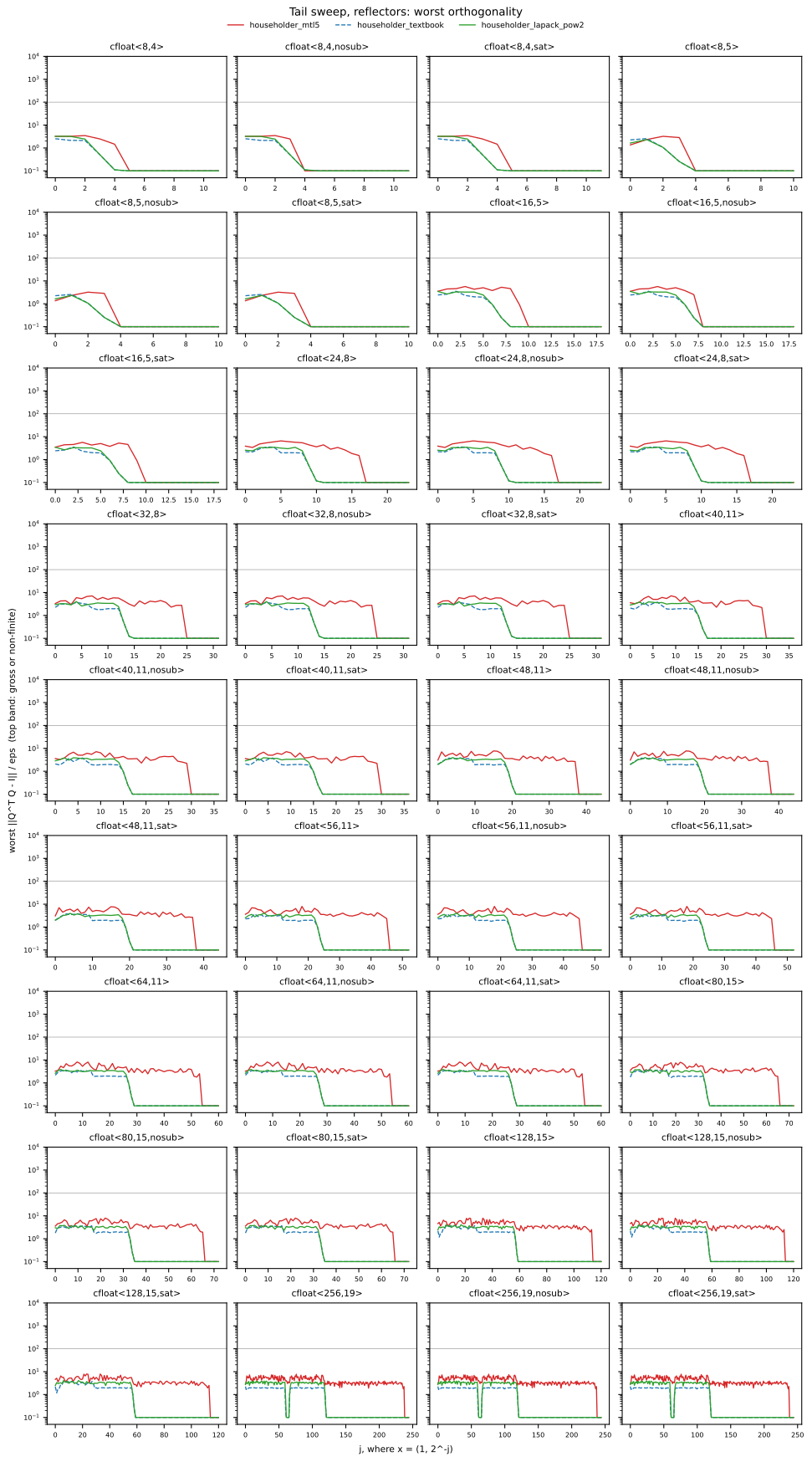
12. The wide cfloats behave as IEEE does, at every width. cfloat<80,15>, <128,15> and <256,19> reproduce findings 1 to 6: the unscaled forms are limited to half the range, the scaled ones are clean to within 2.2 eps, and MTL5’s reflector stays within 9 eps. The one excess is at the bottom edge of the unscaled band, where the squares are subnormal: 1.8×10¹⁹ eps (2^-48) in cfloat<128,15>.
What this suggested for MTL5
Section titled “What this suggested for MTL5”Both were filed as MTL5 issues and adopted on MTL5 main, to ship in 5.22.0:
apply_givens_rotation, and the same formula in MINRES and the symmetric QR iteration, could scale by an exact power of two before squaring, asgivens_pow2_scaleddoes. In IEEE that costs two exponent extractions and removes the half-range limit; in a posit, takum, dd, lns or fixed point it also keeps the accuracy. It was the only rotation clean and accurate in all 65 types (mtl5#671, done in mtl5#673).householder()could reflect onto −sign(x₀)‖x‖e₁, asdlarfgdoes. That changes the sign of R’s diagonal, which MTL5 5.21.0 kept positive (mtl5#672, done in mtl5#675, which also scales by an exact power of two and addsqr_normalize_signsfor the old sign).- Thresholds taken from
std::numeric_limitsdescribe where a type overflows, not where it is precise. Tapered types, dd and qd need the second.
Rerun against MTL5 5.22.0
Section titled “Rerun against MTL5 5.22.0”The study was rerun against MTL5 5.22.0 (cf2f8a5, mp-numerics 7fedb19,
Universal 85172d9). With the remedies adopted, givens_mtl5 should reproduce
givens_pow2_scaled and householder_mtl5 should reproduce
householder_lapack_pow2. Comparing the two rows of each pair, every column of
every input class:
| pair | identical rows (base, scale, tail, repeat) |
|---|---|
givens_mtl5 vs givens_pow2_scaled | 57/57, 6947/7177, 3139/3139, 1368/1368 |
householder_mtl5 vs householder_lapack_pow2 | 44/57, 6923/7177, 3057/3139, 905/1368 |
Outside the table below, the rows that differ do so at the rounding level:
each pair’s worst errors are within 20% of each other. The reflector rounds
differently because MTL5 forms x₀² + Σᵢ₌₁ xᵢ², adding x₀² last, where
householder_lapack_pow2 sums from x₀.
The exception is the exponents nearest each end of the range in the es = 2 posits and takum<8>. There MTL5’s adopted forms fail, and the remedies don’t. The worst ‖GᵀG − I‖ over the scale sweep:
| type | givens_mtl5 | givens_pow2_scaled | householder_mtl5 | householder_lapack_pow2 |
|---|---|---|---|---|
| posit<8,2> | 1.05×10⁶ eps (192 gross) | 1.32 eps | 8 eps | 3.22 eps |
| posit<16,2> | 1.2×10¹⁸ eps (384 gross) | 1.80 eps | 2.1×10³ eps (331 gross) | 3.83 eps |
| posit<32,2> | 1.4×10⁴² eps (384 gross) | 1.98 eps | 1.3×10⁸ eps (333 gross) | 4.76 eps |
| posit<64,2> | 2.0×10⁹⁰ eps (384 gross) | 2.01 eps | 5.8×10¹⁷ eps (326 gross) | 4.28 eps |
| takum<8> | 7.1×10⁷² eps (1,376 gross) | 1.12 eps | 8 eps | 3.28 eps |
The scaling itself is exact. The fault is in how MTL5 finds the exponent to
scale by. pow2_scaling<T>::exponent(m) halves m toward [1, 2) and stops when
a halving doesn’t decrease it, taking that for a non-finite m. Near the ends of
a tapered type’s range, not every binade is representable, so m·½ can round
back to m. The search then stops early, often at e = 0:
- posit<16,2> at 2⁵⁶ gets e = 0 against 52.
- takum<8> at 2¹⁰⁰ to 2²⁵⁰ gets e = 0 against 103 to 239.
The rotation then squares unscaled values. This study’s binary_exponent reads
the exponent through double after exact power-of-two steps, and gets all of
these right. The same search costs one multiplication per binade: 88 ms per
call for cfloat<256,19> near 2²⁰⁰⁰⁰⁰, against 0.014 ms here. That is the two
hours. Both are filed as
mtl5#680, and fixed on MTL5
main; see Rerun against MTL5 main.
The rerun also moved the remedies’ own rows in dd and qd: 5 base, 743 dd and 43 qd scale, and 140 tail rows. The two runs used different Universal commits: 2d5c785 for the committed results, 85172d9 for the rerun. Between them Universal fixed the dd and qd defects this study reported:
- the
two_prodresidual at the top of the double range (universal#1884); - the
numeric_limitstraits (universal#1887, universal#1890); - sums at the top of the range (universal#1892);
- dd’s
sqrt(85172d9).
These address universal#1881, universal#1882 and universal#1883. The dd and qd findings above describe Universal at 2d5c785.
The committed results stay those of 5.21.0, which the findings above describe.
Rerun against MTL5 main
Section titled “Rerun against MTL5 main”mtl5#681 fixed
mtl5#680 on MTL5 main.
pow2_scaling’s fallback now reads the exponent through double, as
binary_exponent does here, and steps by squared powers of two where a type’s
range passes double’s. The study was rerun against MTL5 main at 8b31047, with
mp-numerics 92e26d0 and the same Universal as the 5.22.0 rerun, 85172d9, so
MTL5 is the only change between the two. The full run took 235 s, against
7,974 s for 5.22.0.
Identical rows, counted as above:
| pair | 5.22.0 (base, scale, tail, repeat) | main |
|---|---|---|
givens_mtl5 vs givens_pow2_scaled | 57/57, 6947/7177, 3139/3139, 1368/1368 | 57/57, 7152/7177, 3139/3139, 1368/1368 |
householder_mtl5 vs householder_lapack_pow2 | 44/57, 6923/7177, 3057/3139, 905/1368 | 44/57, 7131/7177, 3057/3139, 905/1368 |
The failures are gone. The worst ‖GᵀG − I‖ over the scale sweep, now with no gross samples in any of these types:
| type | givens_mtl5 | givens_pow2_scaled | householder_mtl5 | householder_lapack_pow2 |
|---|---|---|---|---|
| posit<8,2> | 1.32 eps | 1.32 eps | 3.22 eps | 3.22 eps |
| posit<16,2> | 1.80 eps | 1.80 eps | 3.83 eps | 3.83 eps |
| posit<32,2> | 1.98 eps | 1.98 eps | 4.76 eps | 4.76 eps |
| posit<64,2> | 2.01 eps | 2.01 eps | 4.28 eps | 4.28 eps |
| takum<8> | 1.12 eps | 1.12 eps | 3.28 eps | 3.28 eps |
Of the rows that still differ, all but 20 are unchanged from the 5.22.0 rerun, the differences described there. The 20 new ones are takums:
- takum<8>: 11 rotation rows, from 2⁻²³⁹ to 2⁻²³³ and four from 2²³³ to 2²³⁹, and 7 reflector rows, from 2⁻²³⁹ to 2⁻²³³. They differ at the rounding level, in both directions. At the low end the rotation’s ‖GᵀG − I‖ is 1 eps against 0.44 eps, and the reflector’s annihilation error 0.19 eps against 0.92 eps.
- takum<32>, takum<64>: one rotation row each, at 2⁻²⁵⁴, where the error in r is 86 to 88 eps against 58 to 62 eps.
Both scalings multiply once by 2^k where 2^k is a value of the type. From
2^±233 to 2^±237 it is not a value of takum<8>, and rounds to 2^±239:
scale_pow2 here multiplies by that rounded 2^k, where MTL5 steps x by exact
powers of two instead, so the two round differently.
The .sysinfo sidecars of this run record universal_commit=unknown, because
Universal was used as an exported tree rather than a clone. The CSVs are not
committed.
Universal behaviour met along the way
Section titled “Universal behaviour met along the way”Not changed here; filed in Universal so the results can be read correctly.
std::numeric_limits<dd>::max()is not a normalized pair: its low limb is more than half an ulp of its high limb, so it converts to an infinity, andmax() * dd(1)is NaN. The study takes dd’s top from double (universal#1882).- dd and qd products near
DBL_MAXreturn NaN: Universal’s Dekker split rounds the high half of a value nearDBL_MAXup to 2^1024, sodd(DBL_MAX) * dd(0x1p-512)is a NaN. dd_cascade’s division hits the same split. The study scales dd and qd with their own limb-wiseldexp(universal#1881). std::numeric_limits<dd>::min()is 2^-969, where dd still has full precision, butmin_exponentis double’s −1021 (finding 11, universal#1882).- dd’s
sqrtis not correctly rounded: up to 7.9 units of 2^-106 (3.96 dd eps) against a qd reference on [1, 4), where dd_cascade’s is within 0.75 (universal#1883). The cfloat, lns, takum and qd square roots are correctly rounded.
Figures
Section titled “Figures”plot.py draws them from results/ into figures/.
| figure | shows |
|---|---|
scale_clean_range.svg | the share of each type’s exponent range where every sample is clean, per operator; each sampled exponent counts for the span of exponents it stands for, and one where every input flushes to zero counts as not clean |
scale_rotations_ieee_posit_fixpnt.svg, scale_rotations_cfloat.svg, scale_rotations_lns_takum_dd_qd.svg, scale_reflectors_ieee_posit_fixpnt.svg, scale_reflectors_cfloat.svg, scale_reflectors_lns_takum_dd_qd.svg | worst orthogonality across the exponent range, one panel per type; gross and non-finite rows are drawn in a band above the largest finite error |
tail_reflectors_ieee_posit_fixpnt.svg, tail_reflectors_cfloat.svg, tail_reflectors_lns_takum_dd_qd.svg | worst orthogonality of the three reflectors across the tail sweep |
repeat_power.svg, repeat_product.svg | deviation against k for repeated application, one line per type, over the trials that stayed finite; an x marks a checkpoint where some trials overflowed, a triangle at the top one where all did |
Tables
Section titled “Tables”Generated by summarize.py from results/. Each entry is in units of the
type’s eps.
Scale sweep
Section titled “Scale sweep”Each entry gives the range of k with no gross or non-finite sample, then the worst orthogonality within it.
| type | range of k | givens_mtl5 | givens_max_scaled | givens_safe_scaled | givens_pow2_scaled | householder_mtl5 | householder_textbook | householder_lapack_pow2 |
|---|---|---|---|---|---|---|---|---|
| float | -149..127 | -74..63, 3.89 | -147..127, 2.1e+06 | all, 1.99 | all, 1.99 | all, 7.62 | -74..63, 3.5e+06 | all, 4.42 |
| double | -1074..1023 | -533..509, 1.23 | -1072..1023, 1.1e+15 | all, 1.85 | all, 1.46 | all, 8.44 | -533..509, 1.9e+13 | all, 4.31 |
| long double | -16445..16383 | -8186..8124, 1.99 | -16443..16383, 2.3e+18 | all, 1.99 | all, 2.07 | all, 9.09 | -8186..8124, 3.22 | all, 4.76 |
| posit<8,2> | -24..24 | -24..12, 8 | all, 8 | all, 5.75 | all, 1.32 | all, 3.47 | -24..12, 8 | all, 3.22 |
| posit<16,2> | -56..56 | -28..28, 72 | -43..44, 512 | all, 42.5 | all, 1.8 | all, 15.6 | -18..17, 682 | all, 3.83 |
| posit<32,2> | -120..120 | -60..60, 2.0e+04 | -108..108, 3.4e+07 | all, 9.08e+03 | all, 1.98 | all, 69.6 | -49..49, 4.4e+07 | all, 4.76 |
| posit<64,2> | -248..248 | -120..120, 5.0e+08 | -232..239, 1.4e+17 | all, 5.0e+08 | all, 2.01 | all, 33.6 | -114..111, 1.9e+17 | all, 4.28 |
| posit<16,1> | -28..28 | -13..14, 45 | -25..24, 1.02e+03 | all, 45 | all, 1.44 | all, 68.6 | -10..9, 1.36e+03 | all, 3.76 |
| fixpnt<16,8,mod> | -8..6 | -4..3, 16 | -7..6, 64 | all, 12.2 | all, 1.63 | all, 67.4 | -3..2, 59.4 | all, 2.94 |
| fixpnt<16,8,sat> | -8..6 | -4..3, 50.6 | -7..6, 64 | all, 12.2 | all, 1.56 | all, 67.4 | -3..2, 59.4 | all, 2.75 |
| fixpnt<32,16,mod> | -16..14 | -8..7, 327 | -15..14, 1.6e+04 | all, 252 | all, 1.83 | all, 2.01e+03 | -7..6, 1.3e+04 | all, 4.43 |
| fixpnt<32,16,sat> | -16..14 | -8..7, 1.03e+03 | -15..14, 1.6e+04 | all, 1.03e+03 | all, 1.83 | all, 2.08e+03 | -7..6, 2.5e+04 | all, 3.68 |
| cfloat<8,4> | -9..7 | -9..3, 1.06 | all, 8 | all, 1.32 | all, 1.12 | -9..6, 3.47 | -9..2, 3.53 | -9..6, 3.22 |
| cfloat<8,4,nosub> | -6..7 | -6..3, 2.53 | all, 1.32 | all, 1.32 | all, 1.06 | -6..6, 3.47 | -6..2, 2.94 | -6..6, 2.55 |
| cfloat<8,4,sat> | -9..7 | -9..4, 2.62 | all, 8 | all, 1.32 | all, 1.12 | all, 3.47 | -9..3, 3.93 | all, 3.22 |
| cfloat<8,5> | -16..15 | -16..7, 1.31 | all, 1 | all, 1.31 | all, 1.31 | -16..13, 3.22 | -16..6, 3.06 | -16..14, 3.22 |
| cfloat<8,5,nosub> | -14..15 | -14..7, 1.31 | all, 1 | all, 1.31 | all, 1.31 | -14..14, 3.22 | -14..6, 3.06 | -14..14, 3.22 |
| cfloat<8,5,sat> | -16..15 | -16..8, 2.81 | all, 1 | all, 1.31 | all, 1.31 | all, 3.22 | -16..7, 4.16 | all, 3.22 |
| cfloat<16,5> | -24..15 | -12..7, 1.2 | -22..15, 256 | all, 1.79 | all, 1.79 | -24..14, 6.24 | -11..6, 214 | -24..14, 3.89 |
| cfloat<16,5,nosub> | -13..15 | -6..7, 264 | all, 2.23 | all, 1.67 | all, 1.2 | all, 6.23 | -6..6, 240 | all, 3.89 |
| cfloat<16,5,sat> | -24..15 | -12..8, 1.84 | -22..15, 256 | all, 1.79 | all, 1.79 | all, 6.24 | -11..7, 214 | all, 3.89 |
| cfloat<24,8> | -141..127 | -70..63, 1.23 | -139..127, 8.19e+03 | all, 2.08 | all, 2.08 | all, 9.05 | -70..63, 1.4e+04 | all, 4.18 |
| cfloat<24,8,nosub> | -126..127 | -126..63, 1.1e+04 | all, 2.46 | all, 1.74 | all, 1.25 | all, 9.05 | -126..63, 1.0e+04 | all, 4.18 |
| cfloat<24,8,sat> | -141..127 | -70..63, 1.23 | -139..127, 8.19e+03 | all, 2.08 | all, 2.08 | all, 9.05 | -70..63, 1.4e+04 | all, 4.18 |
| cfloat<32,8> | -149..127 | -74..63, 4.11 | -147..127, 2.1e+06 | all, 1.77 | all, 1.68 | all, 8.3 | -74..63, 3.9e+06 | all, 5.24 |
| cfloat<32,8,nosub> | -125..127 | -62..63, 2.7e+06 | all, 2.4 | all, 1.77 | all, 1.28 | all, 8.14 | -62..63, 2.7e+06 | all, 4.25 |
| cfloat<32,8,sat> | -149..127 | -74..63, 4.11 | -147..127, 2.1e+06 | all, 1.77 | all, 1.68 | all, 8.3 | -74..63, 3.9e+06 | all, 5.24 |
| cfloat<40,11> | -1050..1023 | -515..501, 1.26 | -1049..1023, 6.7e+07 | all, 1.77 | all, 1.39 | all, 7.82 | -515..501, 455 | all, 4.66 |
| cfloat<40,11,nosub> | -1021..1023 | -508..509, 3.5e+06 | all, 2.49 | all, 1.77 | all, 1.26 | all, 7.82 | -508..509, 3.5e+06 | all, 4.66 |
| cfloat<40,11,sat> | -1050..1023 | -515..501, 1.26 | -1049..1023, 6.7e+07 | all, 1.77 | all, 1.39 | all, 7.82 | -515..501, 455 | all, 4.66 |
| cfloat<48,11> | -1058..1023 | -521..499, 1.24 | -1056..1023, 1.7e+10 | all, 1.89 | all, 1.89 | all, 7.85 | -521..499, 1.2e+06 | all, 4.45 |
| cfloat<48,11,nosub> | -1021..1023 | -508..509, 1.0e+09 | all, 2.34 | all, 1.87 | all, 1.25 | all, 7.85 | -508..509, 2.0e+08 | all, 4.45 |
| cfloat<48,11,sat> | -1058..1023 | -521..499, 1.24 | -1056..1023, 1.7e+10 | all, 1.89 | all, 1.89 | all, 7.85 | -521..499, 1.2e+06 | all, 4.45 |
| cfloat<56,11> | -1066..1023 | -527..511, 1.23 | -1064..1023, 4.4e+12 | all, 1.78 | all, 1.72 | all, 7.61 | -527..511, 5.2e+09 | all, 4.52 |
| cfloat<56,11,nosub> | -1021..1023 | -508..509, 2.5e+11 | all, 2.46 | all, 1.78 | all, 1.23 | all, 7.61 | -508..509, 2.5e+11 | all, 4.52 |
| cfloat<56,11,sat> | -1066..1023 | -527..511, 1.23 | -1064..1023, 4.4e+12 | all, 1.78 | all, 1.72 | all, 7.61 | -527..511, 5.2e+09 | all, 4.52 |
| cfloat<64,11> | -1074..1023 | -533..509, 1.24 | -1072..1023, 1.1e+15 | all, 1.87 | all, 1.75 | all, 7.68 | -533..509, 2.8e+13 | all, 4.44 |
| cfloat<64,11,nosub> | -1021..1023 | -508..509, 6.6e+13 | all, 2.52 | all, 1.87 | all, 1.27 | all, 7.51 | -508..509, 6.6e+13 | all, 4.44 |
| cfloat<64,11,sat> | -1074..1023 | -533..509, 1.24 | -1072..1023, 1.1e+15 | all, 1.87 | all, 1.75 | all, 7.68 | -533..509, 2.8e+13 | all, 4.44 |
| cfloat<80,15> | -16446..16383 | -8187..8124, 2.07 | -16444..16383, 4.6e+18 | all, 2.07 | all, 2.14 | all, 7.36 | -8187..8124, 3.1 | all, 4.88 |
| cfloat<80,15,nosub> | -16381..16383 | -8139..8140, 2.07 | all, 2.61 | all, 2.07 | all, 2.14 | all, 7.36 | -8139..8140, 3.1 | all, 4.88 |
| cfloat<80,15,sat> | -16446..16383 | -8187..8124, 2.07 | -16444..16383, 4.6e+18 | all, 2.07 | all, 2.14 | all, 7.36 | -8187..8124, 3.1 | all, 4.88 |
| cfloat<128,15> | -16494..16383 | -8223..8112, 1.8e+19 | -16492..16383, 1.3e+33 | all, 1.88 | all, 1.79 | all, 8.88 | -8223..8112, 2.3e+19 | all, 5.07 |
| cfloat<128,15,nosub> | -16381..16383 | -8139..8140, 1.52 | all, 2.7 | all, 1.88 | all, 1.79 | all, 8.88 | -8139..8140, 2.78 | all, 5.07 |
| cfloat<128,15,sat> | -16494..16383 | -8223..8112, 1.8e+19 | -16492..16383, 1.3e+33 | all, 1.88 | all, 1.79 | all, 8.88 | -8223..8112, 2.3e+19 | all, 5.07 |
| cfloat<256,19> | -262378..262143 | -130423..130188, 1.44 | -262376..262143, 2.8e+70 | all, 1.89 | all, 1.45 | all, 8.48 | -130423..130188, 2.85 | all, 4.31 |
| cfloat<256,19,nosub> | -262141..262143 | -130246..130247, 1.44 | all, 2.58 | all, 1.89 | all, 1.52 | all, 8.48 | -130246..130247, 2.85 | all, 4.31 |
| cfloat<256,19,sat> | -262378..262143 | -130423..130188, 1.44 | -262376..262143, 2.8e+70 | all, 1.89 | all, 1.45 | all, 8.48 | -130423..130188, 2.85 | all, 4.31 |
| lns<8,3> | -7..7 | -7..4, 4 | all, 1.44 | all, 1.44 | all, 1 | all, 2.43 | -7..3, 7.15 | all, 2.5 |
| lns<16,10> | -15..15 | -7..8, 484 | all, 1.5 | all, 1.5 | all, 0.994 | all, 3.11 | -7..7, 374 | all, 2.85 |
| lns<32,23> | -127..127 | -62..64, 5.7e+05 | all, 1.5 | all, 1.5 | all, 0.996 | all, 3.34 | -62..63, 5.8e+05 | all, 2.93 |
| takum<8> | -239..239 | -239..122, 8 | all, 8 | -239..239, 8 | all, 1.12 | all, 5.78 | -239..107, 8 | all, 3.28 |
| takum<16> | -255..254 | -127..126, 669 | all, 106 | all, 50.3 | all, 3.65 | all, 30.2 | -127..126, 599 | all, 6 |
| takum<32> | -255..254 | -127..126, 4.5e+07 | all, 126 | all, 55.8 | all, 3.74 | all, 53.6 | -127..126, 4.4e+07 | all, 7.91 |
| takum<64> | -255..254 | -127..126, 1.9e+17 | all, 117 | all, 94.9 | all, 3.65 | all, 60.8 | -127..126, 1.9e+17 | all, 7.62 |
| dd | -1074..1023 | -533..509, 4.7e+21 | -1072..1023, 1.0e+31 | all, 6.5e+13 | all, 3.79 | all, 8.92 | -533..509, 1.9e+29 | all, 4.2 |
| qd | -1074..1023 | -533..509, 9.6e+52 | -1073..1023, 2.1e+62 | all, 1.4e+45 | all, 0.133 | all, 0.187 | -533..509, 3.8e+60 | all, 0.149 |
Tail sweep
Section titled “Tail sweep”The worst orthogonality, and the first j at which the routine returns the
identity (I). The fixed-point identities of householder_lapack_pow2 start
where the tail rounds to zero in the type.
| type | givens_mtl5 | givens_max_scaled | givens_safe_scaled | givens_pow2_scaled | householder_mtl5 | householder_textbook | householder_lapack_pow2 |
|---|---|---|---|---|---|---|---|
| float | 1.61 | 1.61 | 1.61 | 1.61 | 8.3 (I from j=22) | 3.49 | 4.07 |
| double | 1.77 | 1.66 | 1.77 | 1.77 | 7.43 (I from j=51) | 3.89 | 3.98 |
| long double | 1.66 | 2.26 | 1.66 | 1.66 | 8.53 (I from j=62) | 3.85 | 3.71 |
| posit<8,2> | 1.32 | 1.69 | 1.32 | 1.32 | 3.47 (I from j=3) | 2.53 | 3.22 |
| posit<16,2> | 1.88 | 1.48 | 1.88 | 1.88 | 23.3 (I from j=8) | 3.66 | 4.02 |
| posit<32,2> | 1.79 | 2.22 | 1.79 | 1.79 | 512 (I from j=18) | 3.56 | 3.8 |
| posit<64,2> | 1.91 | 1.91 | 1.91 | 1.91 | 8.0e+05 (I from j=40) | 3.9 | 4.14 |
| posit<16,1> | 1.59 | 2.08 | 1.59 | 1.59 | 56.1 (I from j=6) | 6.31 | 3.63 |
| fixpnt<16,8,mod> | 1.44 | 2.15 | 1.44 | 1.44 | 63.8 (I from j=3) | 0.738 | 2.3 (I from j=10) |
| fixpnt<16,8,sat> | 1.67 | 1.86 | 1.67 | 1.67 | 67.4 (I from j=2) | 0.795 | 2.86 (I from j=10) |
| fixpnt<32,16,mod> | 1.77 | 1.77 | 1.77 | 1.77 | 2.36e+03 (I from j=5) | 0.873 | 2.74 (I from j=18) |
| fixpnt<32,16,sat> | 1.99 | 2.6 | 1.99 | 1.99 | 2.41e+03 (I from j=5) | 0.926 | 2.78 (I from j=18) |
| cfloat<8,4> | 1.32 | 1.69 | 1.32 | 1.32 | 3.47 (I from j=3) | 2.53 | 3.22 (I from j=11) |
| cfloat<8,4,nosub> | 1.32 | 1.69 | 1.32 | 1.32 | 3.47 (I from j=3) | 2.53 | 3.22 (I from j=7) |
| cfloat<8,4,sat> | 1.32 | 1.69 | 1.32 | 1.32 | 3.47 (I from j=3) | 2.53 | 3.22 (I from j=11) |
| cfloat<8,5> | 1 | 1 | 1 | 1 | 3.22 (I from j=1) | 2.57 | 2.33 |
| cfloat<8,5,nosub> | 1 | 1 | 1 | 1 | 3.22 (I from j=1) | 2.57 | 2.33 |
| cfloat<8,5,sat> | 1 | 1 | 1 | 1 | 3.22 (I from j=1) | 2.57 | 2.33 |
| cfloat<16,5> | 1.49 | 1.69 | 1.49 | 1.49 | 5.67 (I from j=8) | 3.53 | 3.46 |
| cfloat<16,5,nosub> | 1.49 | 1.69 | 1.49 | 1.49 | 5.67 (I from j=7) | 3.53 | 3.46 (I from j=15) |
| cfloat<16,5,sat> | 1.49 | 1.69 | 1.49 | 1.49 | 5.67 (I from j=8) | 3.53 | 3.46 |
| cfloat<24,8> | 1.6 | 1.6 | 1.6 | 1.6 | 6.56 (I from j=14) | 3.55 | 3.47 |
| cfloat<24,8,nosub> | 1.6 | 1.6 | 1.6 | 1.6 | 6.56 (I from j=14) | 3.55 | 3.47 |
| cfloat<24,8,sat> | 1.6 | 1.6 | 1.6 | 1.6 | 6.56 (I from j=14) | 3.55 | 3.47 |
| cfloat<32,8> | 1.67 | 1.96 | 1.67 | 1.67 | 7.11 (I from j=22) | 3.71 | 4.02 |
| cfloat<32,8,nosub> | 1.67 | 1.96 | 1.67 | 1.67 | 7.11 (I from j=22) | 3.71 | 4.02 |
| cfloat<32,8,sat> | 1.67 | 1.96 | 1.67 | 1.67 | 7.11 (I from j=22) | 3.71 | 4.02 |
| cfloat<40,11> | 1.55 | 1.7 | 1.55 | 1.55 | 7.18 (I from j=27) | 3.79 | 3.89 |
| cfloat<40,11,nosub> | 1.55 | 1.7 | 1.55 | 1.55 | 7.18 (I from j=27) | 3.79 | 3.89 |
| cfloat<40,11,sat> | 1.55 | 1.7 | 1.55 | 1.55 | 7.18 (I from j=27) | 3.79 | 3.89 |
| cfloat<48,11> | 1.62 | 1.83 | 1.62 | 1.62 | 7.72 (I from j=35) | 3.82 | 3.97 |
| cfloat<48,11,nosub> | 1.62 | 1.83 | 1.62 | 1.62 | 7.72 (I from j=35) | 3.82 | 3.97 |
| cfloat<48,11,sat> | 1.62 | 1.83 | 1.62 | 1.62 | 7.72 (I from j=35) | 3.82 | 3.97 |
| cfloat<56,11> | 1.67 | 1.67 | 1.67 | 1.67 | 7.98 (I from j=43) | 3.73 | 4.06 |
| cfloat<56,11,nosub> | 1.67 | 1.67 | 1.67 | 1.67 | 7.98 (I from j=43) | 3.73 | 4.06 |
| cfloat<56,11,sat> | 1.67 | 1.67 | 1.67 | 1.67 | 7.98 (I from j=43) | 3.73 | 4.06 |
| cfloat<64,11> | 1.59 | 1.59 | 1.59 | 1.59 | 8.19 (I from j=51) | 3.73 | 3.89 |
| cfloat<64,11,nosub> | 1.59 | 1.59 | 1.59 | 1.59 | 8.19 (I from j=51) | 3.73 | 3.89 |
| cfloat<64,11,sat> | 1.59 | 1.59 | 1.59 | 1.59 | 8.19 (I from j=51) | 3.73 | 3.89 |
| cfloat<80,15> | 1.71 | 1.71 | 1.71 | 1.71 | 7.95 (I from j=63) | 3.71 | 3.84 |
| cfloat<80,15,nosub> | 1.71 | 1.71 | 1.71 | 1.71 | 7.95 (I from j=63) | 3.71 | 3.84 |
| cfloat<80,15,sat> | 1.71 | 1.71 | 1.71 | 1.71 | 7.95 (I from j=63) | 3.71 | 3.84 |
| cfloat<128,15> | 1.88 | 2.1 | 1.88 | 1.88 | 7.88 (I from j=111) | 3.8 | 4.08 |
| cfloat<128,15,nosub> | 1.88 | 2.1 | 1.88 | 1.88 | 7.88 (I from j=111) | 3.8 | 4.08 |
| cfloat<128,15,sat> | 1.88 | 2.1 | 1.88 | 1.88 | 7.88 (I from j=111) | 3.8 | 4.08 |
| cfloat<256,19> | 1.5 | 1.5 | 1.5 | 1.5 | 7.72 (I from j=235) | 2.24 | 3.88 |
| cfloat<256,19,nosub> | 1.5 | 1.5 | 1.5 | 1.5 | 7.72 (I from j=235) | 2.24 | 3.88 |
| cfloat<256,19,sat> | 1.5 | 1.5 | 1.5 | 1.5 | 7.72 (I from j=235) | 2.24 | 3.88 |
| lns<8,3> | 1.44 | 1.44 | 1.44 | 1.44 | 2.43 (I from j=4) | 2.09 | 2.09 (I from j=8) |
| lns<16,10> | 1.5 | 1.5 | 1.5 | 1.5 | 2.9 (I from j=8) | 1.97 | 2.9 (I from j=17) |
| lns<32,23> | 1.49 | 1.49 | 1.49 | 1.49 | 3.14 (I from j=25) | 1.99 | 3.14 |
| takum<8> | 2 | 2 | 2 | 1.78 | 6.45 (I from j=1) | 18.3 | 4.18 |
| takum<16> | 2.13 | 2.13 | 2.13 | 2.13 | 29.3 (I from j=7) | 7.26 | 5.15 |
| takum<32> | 3.32 | 1.61 | 3.32 | 3.32 | 96.8 (I from j=22) | 8.88 | 5.75 |
| takum<64> | 2.35 | 2.35 | 2.35 | 2.35 | 207 (I from j=53) | 8.75 | 6.07 |
| dd | 4.56 | 4.56 | 4.56 | 4.56 | 5.21 (I from j=106) | 1.91 | 4.81 |
| qd | 0.081 | 0.065 | 0.081 | 0.081 | 0.159 (I from j=215) | 0.0931 | 0.159 |
Repeated application
Section titled “Repeated application”The worst deviation at the largest k, over the trials that stayed finite; “(n/m inf)” counts the trials that overflowed.
power, k = 4096:
| type | givens_mtl5 | givens_max_scaled | givens_safe_scaled | givens_pow2_scaled | householder_mtl5 | householder_textbook | householder_lapack_pow2 |
|---|---|---|---|---|---|---|---|
| float | 2.34e+03 | 3.52e+03 | 2.34e+03 | 2.34e+03 | 147 | 43.2 | 3.56e+03 |
| double | 1.74e+03 | 2.94e+03 | 1.74e+03 | 1.74e+03 | 30.4 | 23.5 | 2.48e+03 |
| long double | 1.87e+03 | 3.46e+03 | 1.87e+03 | 1.87e+03 | 4.71e+03 | 165 | 623 |
| posit<8,2> | 134 | 2.4e+03 | 134 | 134 | 76.2 | 7.63 | 2.45 |
| posit<16,2> | 2.18e+03 | 2.18e+03 | 2.18e+03 | 2.18e+03 | 150 | 14.5 | 28.4 |
| posit<32,2> | 1.43e+03 | 3.33e+03 | 1.43e+03 | 1.43e+03 | 43.8 | 14.4 | 18.3 |
| posit<64,2> | 1.85e+03 | 3.76e+03 | 1.85e+03 | 1.85e+03 | 30.7 | 147 | 1.64e+03 |
| posit<16,1> | 1.73e+03 | 4.7e+03 | 1.73e+03 | 2.27e+03 | 5.4e+04 | 498 | 2.04e+03 |
| fixpnt<16,8,mod> | 3.3e+04 | 3.3e+04 | 3.3e+04 | 3.3e+04 | 3.3e+04 | 7.62 | 5.83 |
| fixpnt<16,8,sat> | 3.4e+04 | 3.3e+04 | 3.4e+04 | 9.44e+03 | 8.5e+03 | 11 | 2.2e+04 |
| fixpnt<32,16,mod> | 5.57e+03 | 3.53e+03 | 5.57e+03 | 2.16e+03 | 1.7e+05 | 8.4 | 629 |
| fixpnt<32,16,sat> | 4.83e+03 | 2.09e+03 | 4.83e+03 | 2.09e+03 | 5.0e+04 | 5.8 | 8.06 |
| cfloat<8,4> | 1.9 (6/8 inf) | 7.86 (5/8 inf) | 1.9 (6/8 inf) | 1.9 (6/8 inf) | 6.75 (1/8 inf) | 4.63 | 3.99 |
| cfloat<8,4,nosub> | 1.9 (6/8 inf) | 7.32 (5/8 inf) | 1.9 (6/8 inf) | 1.9 (6/8 inf) | 6.75 (1/8 inf) | 4.63 | 3.99 |
| cfloat<8,4,sat> | 2.25e+03 | 2.25e+03 | 2.25e+03 | 2.25e+03 | 1.11e+03 | 4.63 | 3.99 |
| cfloat<8,5> | 1.22 (4/8 inf) | 2.49 (1/8 inf) | 1.22 (4/8 inf) | 1.22 (4/8 inf) | 4 | 5.4 | 5.4 |
| cfloat<8,5,nosub> | 1.22 (4/8 inf) | 2.49 (1/8 inf) | 1.22 (4/8 inf) | 1.22 (4/8 inf) | 4 | 5.4 | 5.4 |
| cfloat<8,5,sat> | 2.7e+05 | 2.6e+05 | 2.7e+05 | 2.7e+05 | 4 | 5.4 | 5.4 |
| cfloat<16,5> | 7.96e+03 | 1.6e+04 | 7.96e+03 | 7.96e+03 | 972 (1/8 inf) | 25.3 | 51 |
| cfloat<16,5,nosub> | 7.96e+03 | 1.6e+04 | 7.96e+03 | 7.96e+03 | 972 (1/8 inf) | 25.3 | 51 |
| cfloat<16,5,sat> | 7.96e+03 | 1.6e+04 | 7.96e+03 | 7.96e+03 | 3.9e+06 | 25.3 | 51 |
| cfloat<24,8> | 1.9e+03 | 2.73e+03 | 1.9e+03 | 1.9e+03 | 2.12e+03 | 608 | 6.77e+03 |
| cfloat<24,8,nosub> | 1.9e+03 | 2.73e+03 | 1.9e+03 | 1.9e+03 | 2.12e+03 | 608 | 6.77e+03 |
| cfloat<24,8,sat> | 1.9e+03 | 2.73e+03 | 1.9e+03 | 1.9e+03 | 2.12e+03 | 608 | 6.77e+03 |
| cfloat<32,8> | 1.03e+03 | 2.71e+03 | 1.03e+03 | 1.03e+03 | 5.23e+03 | 76.2 | 255 |
| cfloat<32,8,nosub> | 1.03e+03 | 2.71e+03 | 1.03e+03 | 1.03e+03 | 5.23e+03 | 76.2 | 255 |
| cfloat<32,8,sat> | 1.03e+03 | 2.71e+03 | 1.03e+03 | 1.03e+03 | 5.23e+03 | 76.2 | 255 |
| cfloat<40,11> | 1.09e+03 | 1.09e+03 | 1.09e+03 | 1.09e+03 | 4.31e+03 | 17 | 61.6 |
| cfloat<40,11,nosub> | 1.09e+03 | 1.09e+03 | 1.09e+03 | 1.09e+03 | 4.31e+03 | 17 | 61.6 |
| cfloat<40,11,sat> | 1.09e+03 | 1.09e+03 | 1.09e+03 | 1.09e+03 | 4.31e+03 | 17 | 61.6 |
| cfloat<48,11> | 1.47e+03 | 2.44e+03 | 1.47e+03 | 1.47e+03 | 8.16e+03 | 2.17e+03 | 2.66e+03 |
| cfloat<48,11,nosub> | 1.47e+03 | 2.44e+03 | 1.47e+03 | 1.47e+03 | 8.16e+03 | 2.17e+03 | 2.66e+03 |
| cfloat<48,11,sat> | 1.47e+03 | 2.44e+03 | 1.47e+03 | 1.47e+03 | 8.16e+03 | 2.17e+03 | 2.66e+03 |
| cfloat<56,11> | 878 | 4.08e+03 | 878 | 878 | 1.1e+04 | 121 | 53.1 |
| cfloat<56,11,nosub> | 878 | 4.08e+03 | 878 | 878 | 1.1e+04 | 121 | 53.1 |
| cfloat<56,11,sat> | 878 | 4.08e+03 | 878 | 878 | 1.1e+04 | 121 | 53.1 |
| cfloat<64,11> | 1.77e+03 | 1.77e+03 | 1.77e+03 | 1.77e+03 | 8.04e+03 | 71.1 | 6.93e+03 |
| cfloat<64,11,nosub> | 1.77e+03 | 1.77e+03 | 1.77e+03 | 1.77e+03 | 8.04e+03 | 71.1 | 6.93e+03 |
| cfloat<64,11,sat> | 1.77e+03 | 1.77e+03 | 1.77e+03 | 1.77e+03 | 8.04e+03 | 71.1 | 6.93e+03 |
| cfloat<80,15> | 1.36e+03 | 2.52e+03 | 1.36e+03 | 1.36e+03 | 1.69e+03 | 63.6 | 171 |
| cfloat<80,15,nosub> | 1.36e+03 | 2.52e+03 | 1.36e+03 | 1.36e+03 | 1.69e+03 | 63.6 | 171 |
| cfloat<80,15,sat> | 1.36e+03 | 2.52e+03 | 1.36e+03 | 1.36e+03 | 1.69e+03 | 63.6 | 171 |
| cfloat<128,15> | 2.26e+03 | 3.76e+03 | 2.26e+03 | 2.26e+03 | 7.73e+03 | 97.4 | 117 |
| cfloat<128,15,nosub> | 2.26e+03 | 3.76e+03 | 2.26e+03 | 2.26e+03 | 7.73e+03 | 97.4 | 117 |
| cfloat<128,15,sat> | 2.26e+03 | 3.76e+03 | 2.26e+03 | 2.26e+03 | 7.73e+03 | 97.4 | 117 |
| cfloat<256,19> | 1.55e+03 | 2.4e+03 | 1.55e+03 | 1.55e+03 | 4.92e+03 | 3.61e+03 | 2.69e+03 |
| cfloat<256,19,nosub> | 1.55e+03 | 2.4e+03 | 1.55e+03 | 1.55e+03 | 4.92e+03 | 3.61e+03 | 2.69e+03 |
| cfloat<256,19,sat> | 1.55e+03 | 2.4e+03 | 1.55e+03 | 1.55e+03 | 4.92e+03 | 3.61e+03 | 2.69e+03 |
| lns<8,3> | 2.99e+03 | 2.99e+03 | 2.99e+03 | 2.99e+03 | 2.04e+03 | 871 | 1.86e+03 |
| lns<16,10> | 4.15e+03 | 3.08e+03 | 4.15e+03 | 4.15e+03 | 2.2e+04 | 2.2e+04 | 2.2e+04 |
| lns<32,23> | 2.05e+03 | 2.65e+03 | 2.05e+03 | 2.05e+03 | 4.1e+03 | 4.1e+03 | 4.1e+03 |
| takum<8> | 71.2 | 71.2 | 71.2 | 71.2 | 6.08 | 11.1 | 2.78 |
| takum<16> | 2.72e+03 | 9.13e+03 | 2.72e+03 | 2.72e+03 | 1.87e+03 | 1.02e+03 | 267 |
| takum<32> | 2.27e+03 | 2.78e+03 | 2.27e+03 | 1.74e+03 | 9.7e+03 | 4.33e+03 | 68 |
| takum<64> | 1.51e+03 | 1.51e+03 | 1.51e+03 | 4.08e+03 | 7.92e+03 | 244 | 1.1e+04 |
| dd | 3.5e+03 | 6.31e+03 | 3.5e+03 | 3.5e+03 | 5.39e+03 | 205 | 5.29e+03 |
| qd | 22.1 | 109 | 22.1 | 22.1 | 143 | 112 | 36.9 |
product, k = 1024:
| type | givens_mtl5 | givens_max_scaled | givens_safe_scaled | givens_pow2_scaled | householder_mtl5 | householder_textbook | householder_lapack_pow2 |
|---|---|---|---|---|---|---|---|
| float | 163 | 127 | 165 | 163 | 94.5 | 104 | 89.2 |
| double | 183 | 124 | 173 | 183 | 87.3 | 98.7 | 92.9 |
| long double | 250 | 60.8 | 251 | 250 | 109 | 113 | 86.2 |
| posit<8,2> | 1.3e+04 | 4.2e+04 | 8.62e+03 | 1.3e+04 | 4.6e+04 | 1.2e+05 | 1.75e+03 |
| posit<16,2> | 158 | 193 | 165 | 159 | 94.7 | 106 | 109 |
| posit<32,2> | 161 | 149 | 163 | 164 | 86.2 | 116 | 86.7 |
| posit<64,2> | 239 | 39.6 | 243 | 249 | 101 | 107 | 93.4 |
| posit<16,1> | 141 | 171 | 150 | 160 | 100 | 143 | 107 |
| fixpnt<16,8,mod> | 508 | 104 | 514 | 85.4 | 200 | 212 | 242 |
| fixpnt<16,8,sat> | 466 | 107 | 487 | 105 | 231 | 175 | 227 |
| fixpnt<32,16,mod> | 417 | 125 | 427 | 84.2 | 224 | 195 | 235 |
| fixpnt<32,16,sat> | 410 | 92 | 388 | 90.7 | 229 | 181 | 218 |
| cfloat<8,4> | 2.1e+04 | 7.5e+04 | 1.0e+04 | 2.1e+04 | 6.8e+04 (2/4 inf) | - (4/4 inf) | 1.04e+03 |
| cfloat<8,4,nosub> | 1.9e+04 | 5.1e+04 | 2.2e+04 | 1.9e+04 | 3.4e+05 (2/4 inf) | - (4/4 inf) | 826 |
| cfloat<8,4,sat> | 2.1e+04 | 7.5e+04 | 1.0e+04 | 2.1e+04 | 4.2e+05 | 1.8e+05 | 1.04e+03 |
| cfloat<8,5> | 1.3e+08 | 4.0e+05 | 6.6e+07 | 1.3e+08 | 4.6e+04 | - (4/4 inf) | 7.0e+06 |
| cfloat<8,5,nosub> | 1.3e+08 | 4.0e+05 | 6.6e+07 | 1.3e+08 | 4.6e+04 | - (4/4 inf) | 7.0e+06 |
| cfloat<8,5,sat> | 1.3e+08 | 4.0e+05 | 6.6e+07 | 1.3e+08 | 4.6e+04 | 1.4e+10 | 7.0e+06 |
| cfloat<16,5> | 164 | 191 | 165 | 164 | 94.6 | 130 | 88.9 |
| cfloat<16,5,nosub> | 166 | 194 | 165 | 166 | 89.9 | 122 | 105 |
| cfloat<16,5,sat> | 164 | 191 | 165 | 164 | 94.6 | 130 | 88.9 |
| cfloat<24,8> | 173 | 136 | 169 | 173 | 87.8 | 92.5 | 88.1 |
| cfloat<24,8,nosub> | 173 | 136 | 169 | 173 | 87.8 | 92.5 | 88.1 |
| cfloat<24,8,sat> | 173 | 136 | 169 | 173 | 87.8 | 92.5 | 88.1 |
| cfloat<32,8> | 174 | 144 | 168 | 174 | 89.4 | 116 | 89.9 |
| cfloat<32,8,nosub> | 174 | 144 | 168 | 174 | 89.4 | 116 | 89.9 |
| cfloat<32,8,sat> | 174 | 144 | 168 | 174 | 89.4 | 116 | 89.9 |
| cfloat<40,11> | 160 | 149 | 159 | 160 | 97.5 | 109 | 87.8 |
| cfloat<40,11,nosub> | 160 | 149 | 159 | 160 | 97.5 | 109 | 87.8 |
| cfloat<40,11,sat> | 160 | 149 | 159 | 160 | 97.5 | 109 | 87.8 |
| cfloat<48,11> | 171 | 131 | 154 | 171 | 97 | 96.8 | 94.6 |
| cfloat<48,11,nosub> | 171 | 131 | 154 | 171 | 97 | 96.8 | 94.6 |
| cfloat<48,11,sat> | 171 | 131 | 154 | 171 | 97 | 96.8 | 94.6 |
| cfloat<56,11> | 172 | 120 | 173 | 172 | 90.2 | 102 | 87.1 |
| cfloat<56,11,nosub> | 172 | 120 | 173 | 172 | 90.2 | 102 | 87.1 |
| cfloat<56,11,sat> | 172 | 120 | 173 | 172 | 90.2 | 102 | 87.1 |
| cfloat<64,11> | 164 | 112 | 163 | 164 | 82 | 120 | 79.5 |
| cfloat<64,11,nosub> | 164 | 112 | 163 | 164 | 82 | 120 | 79.5 |
| cfloat<64,11,sat> | 164 | 112 | 163 | 164 | 82 | 120 | 79.5 |
| cfloat<80,15> | 240 | 43.2 | 233 | 240 | 103 | 104 | 105 |
| cfloat<80,15,nosub> | 240 | 43.2 | 233 | 240 | 103 | 104 | 105 |
| cfloat<80,15,sat> | 240 | 43.2 | 233 | 240 | 103 | 104 | 105 |
| cfloat<128,15> | 47.6 | 43.5 | 46.1 | 47.6 | 85.2 | 87.2 | 94.3 |
| cfloat<128,15,nosub> | 47.6 | 43.5 | 46.1 | 47.6 | 85.2 | 87.2 | 94.3 |
| cfloat<128,15,sat> | 47.6 | 43.5 | 46.1 | 47.6 | 85.2 | 87.2 | 94.3 |
| cfloat<256,19> | 38.1 | 43.6 | 31.7 | 38.1 | 83.9 | 97.5 | 78 |
| cfloat<256,19,nosub> | 38.1 | 43.6 | 31.7 | 38.1 | 83.9 | 97.5 | 78 |
| cfloat<256,19,sat> | 38.1 | 43.6 | 31.7 | 38.1 | 83.9 | 97.5 | 78 |
| lns<8,3> | 286 | 1.5e+04 | 293 | 286 | 1.2e+04 | 2.1e+05 | 591 |
| lns<16,10> | 39.3 | 41.8 | 39.1 | 39.3 | 114 | 131 | 120 |
| lns<32,23> | 33.4 | 41.9 | 33.6 | 33.4 | 125 | 132 | 125 |
| takum<8> | 1.7e+04 | 3.8e+03 | 5.28e+03 | 230 | 714 | 1.8e+04 | 2.32e+03 |
| takum<16> | 173 | 168 | 174 | 100 | 159 | 228 | 156 |
| takum<32> | 168 | 117 | 171 | 79.7 | 149 | 228 | 152 |
| takum<64> | 214 | 75.4 | 211 | 381 | 143 | 234 | 151 |
| dd | 140 | 539 | 145 | 140 | 372 | 53.8 | 366 |
| qd | 1.49 | 1.39 | 1.35 | 1.49 | 2.59 | 1.21 | 3.07 |