Sparse direct solvers against CHOLMOD and PARDISO
The direct entries of mtl5_bench ran at 0.02–1.7% of the roofline, and no
tuned library had been measured on the same problem, so nothing said how much of
that was MTL5 and how much the problem (#810). This page compares MTL5’s sparse
direct solvers with CHOLMOD and MKL PARDISO, one phase at a time, on the same
matrices and with the same backward-error check.
In short. On the 2D grid, even the references reach only 4–9% of peak in the factorization: the problem itself caps the percentage. On the 3D grid they reach 35–41%, and MTL5 is far behind. Its best factorization, the supernodal LDLᵀ, takes 6× CHOLMOD’s time. Its supernodal LU takes 35× PARDISO’s, and is slower than its plain LU. The up-looking Cholesky takes 650× CHOLMOD’s time. The ordering and symbolic analysis are close to the references, and MTL5’s COLAMD-based LU analysis beats PARDISO’s. MTL5’s direct solvers show no substantial parallel scaling: at 8 threads they gain at most 8%. On the two AArch64 boards, against CHOLMOD only, the picture is the same and the gap narrower: the supernodal LDLᵀ takes 3.6–4.8× CHOLMOD’s time on the 3D grid and matches it on the 2D one (AArch64).
The measurement
Section titled “The measurement”-
Machine and sessions. i7-12700K, 8 P-cores,
performancegovernor, two pinned sessions:benchmarks/data/i7-12700k/mtl5_bench/20261113T055208Zand20261113T060838Z, at8867b44, classmedium. At one thread every direct entry agrees between the two sessions within ±2%, except two (3.3% and 6.1%); at 8 threads within ±6.3%. The tables give the second session. -
Problems. Area
directis the 96² 2D grid of the one-shot entries (9,216 unknowns): the 5-point Laplacian for the SPD solvers, and an unsymmetric convection-diffusion operator for the LU solvers. Areadirect3dis the 7-point analogue on a 20³ grid (8,000 unknowns), whose top separator has 400 columns against 96 in 2D. 20³ is set by the up-lookingsparse_cholesky, which takes 7.4 s per factorization there and over ten minutes at 32³. -
Phases. Each solver has an
.analyze(ordering and symbolic), a.factorand a.solveentry. Earlier phases run untimed, and each check is the backward error of a full solve. -
References (the
blasbuild, with-DMTL5_BENCH_REFERENCES=ON):- CHOLMOD: supernodal L Lᵀ and AMD, both forced. It calls OpenBLAS.
- PARDISO:
mtype2 for SPD and 11 for unsymmetric. Minimum degree ordering, which is MKL’s AMD. MKL’s default scaling and matching formtype11.
The MTL5 solvers order with AMD (Cholesky, LDLᵀ) and COLAMD (LU).
-
Work model.
- Factorization: the Cholesky-equivalent count of the AMD-ordered pattern, doubled for LU. So two solvers on one matrix get the same count, and %roof compares them directly.
- Solve: 4 nnz(L) flops and 16 nnz(L) bytes.
- Analysis: no work model, so timed only.
See
benchmarks/platform/entries_direct.hpp.
All MTL5 figures below are from the blas build, beside the references. They
match the native build within 3.4%: none of these solvers calls BLAS here.
Factorization
Section titled “Factorization”One thread, median time, and in parentheses the factor’s multiple of the faster reference:
| problem | sparse_cholesky | supernodal_ldlt | CHOLMOD | PARDISO SPD |
|---|---|---|---|---|
| 2D, 96² | 88.4 ms (47×) | 4.18 ms (2.2×) | 3.39 ms | 1.90 ms |
| 3D, 20³ | 7433 ms (768×) | 69.6 ms (7.2×) | 11.4 ms | 9.68 ms |
| problem | sparse_lu | supernodal_lu | PARDISO LU |
|---|---|---|---|
| 2D, 96² | 35.4 ms (11×) | 47.6 ms (15×) | 3.22 ms |
| 3D, 20³ | 552 ms (29×) | 666 ms (35×) | 19.1 ms |
As a fraction of the f64 FMA peak (78 GFLOP/s on one core):
| problem | sparse_cholesky | supernodal_ldlt | CHOLMOD | PARDISO SPD | sparse_lu | supernodal_lu | PARDISO LU |
|---|---|---|---|---|---|---|---|
| 2D | 0.2% | 3.4% | 4.2% | 7.5% | 0.8% | 0.6% | 8.8% |
| 3D | 0.1% | 5.7% | 34.5% | 40.7% | 1.4% | 1.2% | 41.3% |
- The 2D grid caps everyone. Its supernodes are small, so even PARDISO stays under 9% of peak. The one-shot entries’ 0.02–1.7% is partly the problem: the references’ one-shots are at 2.5–3.8%.
- On the 3D grid the references use the hardware. At 35–41% of peak, their dense supernodal updates run as BLAS-3. MTL5’s supernodal LDLᵀ reaches 5.7%, 6× less on the same count.
supernodal_luis slower thansparse_luon both grids, by 21–35%. Its supernodes do not pay for themselves here.sparse_choleskyis the up-looking algorithm, one row of L at a time with no dense kernel. Its 3D factorization takes 7.4 s, against 70 ms for MTL5’s own supernodal LDLᵀ on the same matrix.
Analysis and solve
Section titled “Analysis and solve”One thread; the multiple is MTL5’s time over the reference’s (CHOLMOD for the SPD solvers, PARDISO for LU):
| entry | 2D | ref | × | 3D | ref | × |
|---|---|---|---|---|---|---|
sparse_cholesky.analyze | 2.36 ms | 1.88 ms | 1.25 | 9.50 ms | 3.91 ms | 2.4 |
supernodal_ldlt.analyze | 4.53 ms | 1.88 ms | 2.4 | 18.7 ms | 3.91 ms | 4.8 |
sparse_lu.analyze | 2.09 ms | 3.59 ms | 0.58 | 4.88 ms | 9.05 ms | 0.54 |
supernodal_lu.analyze | 3.93 ms | 3.59 ms | 1.09 | 11.6 ms | 9.05 ms | 1.29 |
sparse_cholesky.solve | 0.246 ms | 0.327 ms | 0.75 | 1.42 ms | 0.501 ms | 2.8 |
sparse_lu.solve | 0.643 ms | 0.575 ms | 1.12 | 7.51 ms | 1.05 ms | 7.1 |
- The analysis is close. MTL5’s COLAMD-based LU analysis is about twice as fast as PARDISO’s ordering of A + Aᵀ. The supernodal LDLᵀ’s analysis (AMD, then the supernode partition) is the slowest at 4.8× in 3D.
- The 2D solves are even. In 3D, the Cholesky solve is 2.8× CHOLMOD’s (24% of the bandwidth roof against 69%), and the LU solve 7.1× PARDISO’s. The supernodal solvers’ solve times match their plain counterparts, so the supernode structure is not used in the solve.
Threads
Section titled “Threads”8 threads, 3D factorization, session 2:
| solver | 1 thread | 8 threads | speedup |
|---|---|---|---|
| PARDISO SPD | 9.68 ms | 2.38 ms | 4.1× |
| PARDISO LU | 19.1 ms | 5.57 ms | 3.4× |
| CHOLMOD | 11.4 ms | 8.39 ms | 1.4× |
supernodal_ldlt | 69.6 ms | 65.3 ms | 1.07× |
supernodal_lu | 666 ms | 618 ms | 1.08× |
sparse_lu | 552 ms | 540 ms | 1.02× |
MTL5’s direct solvers show no substantial parallel scaling: their 2–8% gains are about the size of the run-to-run spread at 8 threads (up to 6.3% between the two sessions). PARDISO parallelizes over the elimination tree. CHOLMOD gains only what OpenBLAS’s threads give its dense updates.
AArch64: CHOLMOD on the Jetson Orin and the Ventuno Q
Section titled “AArch64: CHOLMOD on the Jetson Orin and the Ventuno Q”The same entries, CHOLMOD only (MKL is x86-only). Second sessions of the
2026-11-13 pairs, blas build, one thread:
- Jetson Orin:
20261113T140622Z, six Cortex-A78AE at 1344 MHz, CHOLMOD 3.0 and OpenBLAS 0.3.20. Its first session agrees within ±5% on 793 of 824 entries. - Ventuno Q:
20261113T135246Z, four Cortex-A78C, CHOLMOD 5.2 and OpenBLAS 0.3.26. Its first session agrees on 780 of 824.
The machine pages have the sessions’ details (Jetson, Ventuno).
Factorization, median time and in parentheses the multiple of CHOLMOD’s:
| machine | problem | sparse_cholesky | supernodal_ldlt | CHOLMOD |
|---|---|---|---|---|
| Jetson Orin | 2D, 96² | 273 ms (13×) | 16.7 ms (0.82×) | 20.4 ms |
| Jetson Orin | 3D, 20³ | 25.7 s (324×) | 282 ms (3.6×) | 79.4 ms |
| Ventuno Q | 2D, 96² | 174 ms (15×) | 11.4 ms (1.01×) | 11.3 ms |
| Ventuno Q | 3D, 20³ | 16.5 s (370×) | 212 ms (4.8×) | 44.5 ms |
| i7-12700K | 2D, 96² | 88.4 ms (26×) | 4.18 ms (1.23×) | 3.39 ms |
| i7-12700K | 3D, 20³ | 7.43 s (652×) | 69.6 ms (6.1×) | 11.4 ms |
On the 3D grid, as a fraction of the f64 FMA peak, CHOLMOD is at 36% (Jetson) and 41% (Ventuno), and the supernodal LDLᵀ at 10% and 9%.
- CHOLMOD reaches the same fraction of peak on all three machines, 35–41%. MTL5’s supernodal LDLᵀ does better on the A78 cores (9–10%) than on the i7 (5.7%), so its gap is smaller there: 3.6–4.8× against 6.1×.
- On the 2D grid the supernodal LDLᵀ matches CHOLMOD on ARM, and is 18% faster on the Jetson. The small supernodes leave CHOLMOD’s BLAS-3 updates little to gain.
- The up-looking
sparse_choleskyis 13–15× behind in 2D and 324–370× in 3D. On the Jetson its 3D factorization takes 26 s. - The analysis and the solve repeat the i7’s pattern. In 3D the
supernodal LDLᵀ’s analysis takes 5.7× CHOLMOD’s on the Jetson and 6.2× on
the Ventuno,
sparse_cholesky’s 2.7× and 2.8×. The Cholesky solve takes 3.3× and 3.2× CHOLMOD’s. - Threads. The Ventuno’s CHOLMOD gains 1.6× on four cores in 3D (44.5 → 27.7 ms). MTL5’s solvers gain 1.06–1.16×, about the ratio of the clock caps of the CPUs a 4-thread run adds (2361 against 2112 MHz). The Jetson’s CHOLMOD is 3.7× slower on six threads than on one; that is OpenBLAS 0.3.20’s threading on that board, not CHOLMOD’s (the diagnostic).
Roofline
Section titled “Roofline”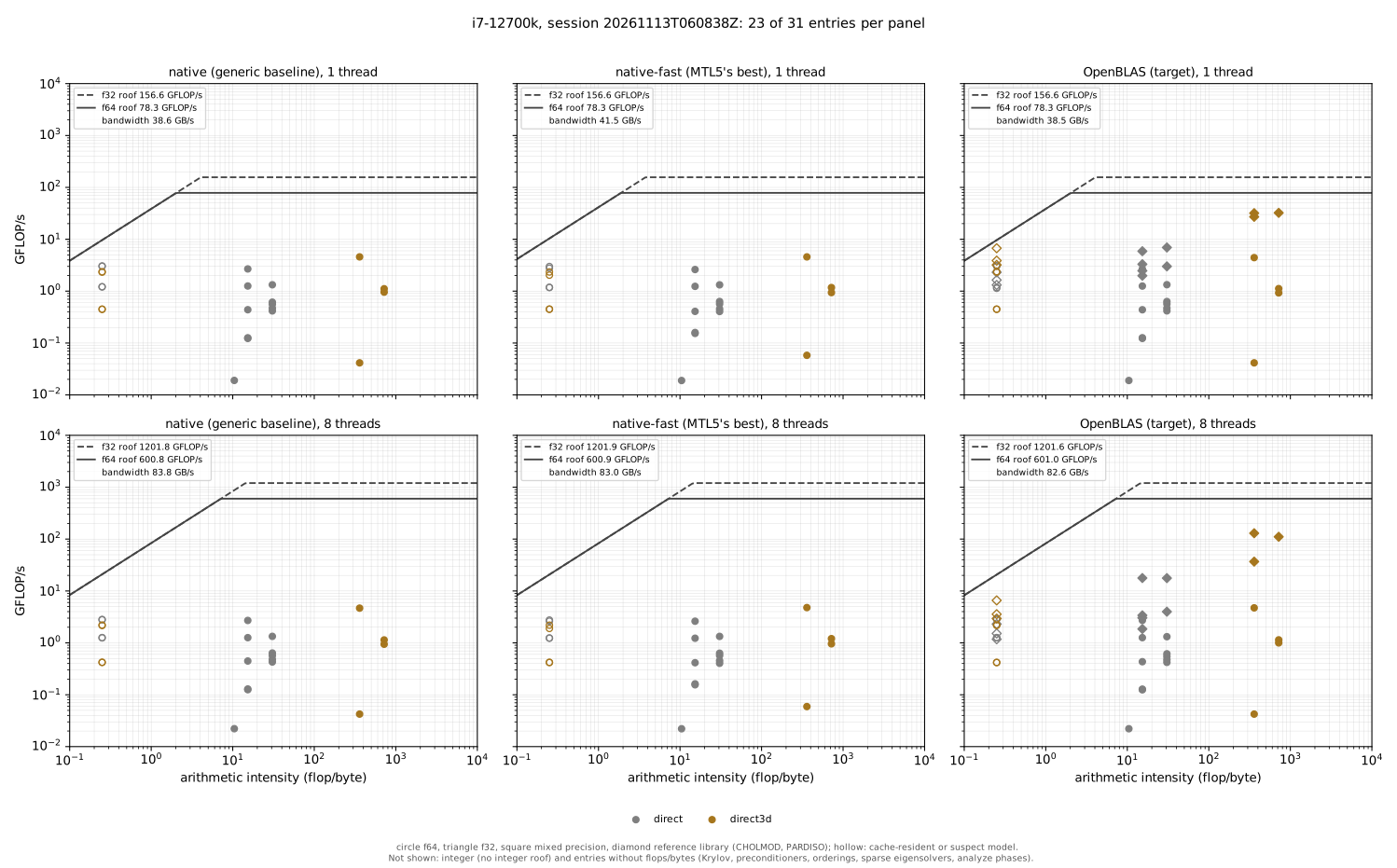
Areas direct (grey) and direct3d (brown) only; diamonds are CHOLMOD and
PARDISO, in the OpenBLAS column. The hollow points at the left are the 2D
solves, whose working set fits in cache. The analyze entries have no work
model and are not placed.
What it points at
Section titled “What it points at”These are directions, not measured fixes:
- A supernodal Cholesky with BLAS-3 updates.
supernodal_ldltis the closest MTL5 has, at 6× CHOLMOD in 3D. Its updates do not reach the roof that CHOLMOD’s dense kernels do. - The supernodal LU’s updates. It is slower than the plain LU, so its dense path costs more than it saves at these supernode sizes.
- Threading the factorization over the elimination tree, where PARDISO gets 4× on 8 cores.
- The solves on 3D problems, 3–7× behind.
Not covered
Section titled “Not covered”- PARDISO on AArch64. MKL is x86-only, so the ARM boards have CHOLMOD only, and the LU solvers no reference there.
- Larger problems. The
largeclass uses 192² and 24³. 32³ and up need a fastersparse_choleskyfirst, or that entry left out. - Real matrices. These are generated grids; the SuiteSparse-collection
matrices of the KLU and SuperLU scoreboards
are not part of
mtl5_bench.
Reproducing
Section titled “Reproducing”benchmarks/machines/i7-12700k-platform.sh # one session; needs SuiteSparse and MKL for the referencesbenchmarks/plot_roofline.py benchmarks/data/i7-12700k/mtl5_bench/20261113T060838Z \ --areas direct,direct3d --out docs/img/benchmarks/intel-i7-12700k/roofline-direct.svg