Givens and Householder across number systems
MTL5’s rotations and reflectors are generic over the scalar type, so they run unchanged on posits, fixed point, logarithmic numbers and wide floats. This page reports what one rotation or one reflector does in 57 number types, measured exactly. These are the results of the first study of the series in mtl5#666, mp-numerics#13. The history explains why these operators are built the way they are, and the pictures and the explorer show them in small formats.
The short version:
- MTL5’s Householder reflector is clean over essentially the whole range of every type. The rotation used by GMRES, MINRES and the symmetric QR iteration is clean over only about half of it.
- Scaling by an exact power of two is the one form clean and accurate in all 57 types. The rotation scaled this way is clean everywhere. The reflector is too, apart from a few overflows in the top binade of the 8- and 16-bit IEEE cfloats. LAPACK’s scalings prevent overflow, but in a tapered type or in double-double they don’t keep the precision.
- MTL5’s choice of sign costs accuracy in posits, takums and fixed point. In IEEE it doesn’t.
What was measured
Section titled “What was measured”Each operator is built for a vector x = (a, b) in the type, and its values are read out as exact Shewchuk expansions. So every number below is the error of the operator the arithmetic produced, not of a double approximation to it. The exception is lns: its values are not dyadic, so they are read through double. That is still far finer than lns<32,23>‘s own resolution.
The main measure is ‖QᵀQ − I‖₂, reported in units of the type’s epsilon(). A
sample is gross when ‖QᵀQ − I‖₂ itself, or the part of x the operator
failed to annihilate relative to ‖x‖, is above max(1/2, 16 eps). Neither
measure is divided by eps for this test. It is non-finite when an infinity or NaN appears.
A sample is clean when it is neither.
| operator | what it is |
|---|---|
givens_mtl5 | mtl::apply_givens_rotation: r = sqrt(a·a + b·b), c = a/r, s = b/r. MINRES and the symmetric QR iteration use the same formula |
givens_max_scaled | divide by max(|a|, |b|) first, as LAPACK’s lapy2 does |
givens_safe_scaled | Anderson’s safe scaling, from Reference-LAPACK dlartg.f90 |
givens_pow2_scaled | scale by an exact 2^-e with 2^e ≤ max(|a|, |b|) |
householder_mtl5 | mtl::householder: max-scaled, Parlett’s sign (onto +‖x‖e₁ for x₀ > 0), v(0) = 1 |
householder_textbook | mtl::householder(x, tag::textbook_reflector): unscaled, LAPACK’s sign |
householder_lapack_pow2 | dlarfg’s sign (onto −sign(x₀)‖x‖e₁), v(0) = 1, on x scaled by an exact 2^-e |
givens_mtl5 and householder_mtl5 are MTL5 5.21.0, which the study measured.
MTL5 5.22.0 adopted the two remedies: apply_givens_rotation, MINRES and the
symmetric QR iteration scale by an exact power of two, as givens_pow2_scaled
does (#671), and householder takes dlarfg’s sign on x scaled by an exact
power of two, as householder_lapack_pow2 does (#672).
The inputs are random directions with ‖x‖ = 2^k for k across each type’s whole exponent range (the scale sweep), and x = (±1, ±2^-j (1 + u)) with u uniform in [0, 1), for j from 0 to past the type’s precision (the tail sweep). A third sweep applies operators repeatedly.
The types are:
- float, double and x87 long double;
- posit<8,2>, <16,1>, <16,2>, <32,2> and <64,2>;
- fixpnt<16,8> and <32,16>, wrapping and saturating;
- cfloat from FP8 (E4M3, E5M2) to 256 bits, each with IEEE behaviour, without subnormals, and saturating;
- lns<8,3>, <16,10> and <32,23>;
- takum<8> to <64>;
- Universal’s dd and qd.
cfloat<32,8> and <64,11> reproduce float’s and double’s measurements bit for bit, so the cfloat rows can be read as IEEE rows.
Where each operator is clean
Section titled “Where each operator is clean”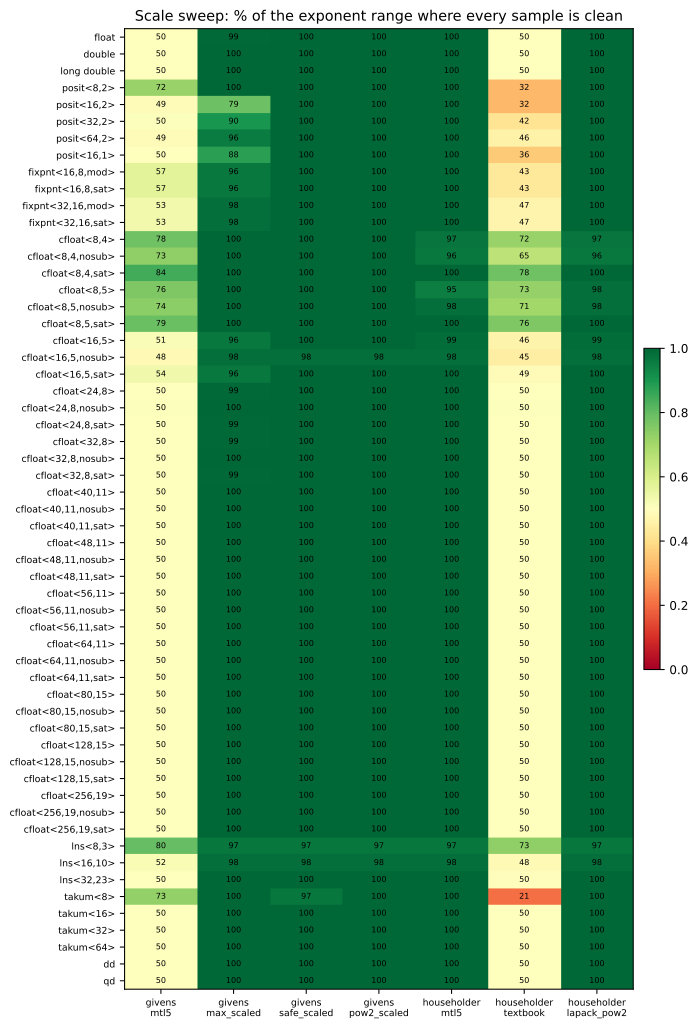
Two columns stand out:
- MTL5’s rotation is clean on half of each range. a·a overflows once |a| passes sqrt(max), and underflows below sqrt(min): in double the clean band is k ∈ [−533, 509] of [−1074, 1023].
- The textbook reflector, also unscaled, has the same limit.
The scaled forms are clean over all or nearly all of every range, with two kinds of exception:
lapy2’s max-scaling turns gross at the ends of the wider posits’ ranges. It is clean on 79 to 96% of them.- Elsewhere, a cell below 100 marks either the bottom of a range, where every input flushes to zero, or a few overflows in the top binade of the 8- and 16-bit IEEE cfloats.
Clean is not the same as accurate, though. The next figure shows the error inside the clean region.
Rotations: scaling against overflow is not scaling for precision
Section titled “Rotations: scaling against overflow is not scaling for precision”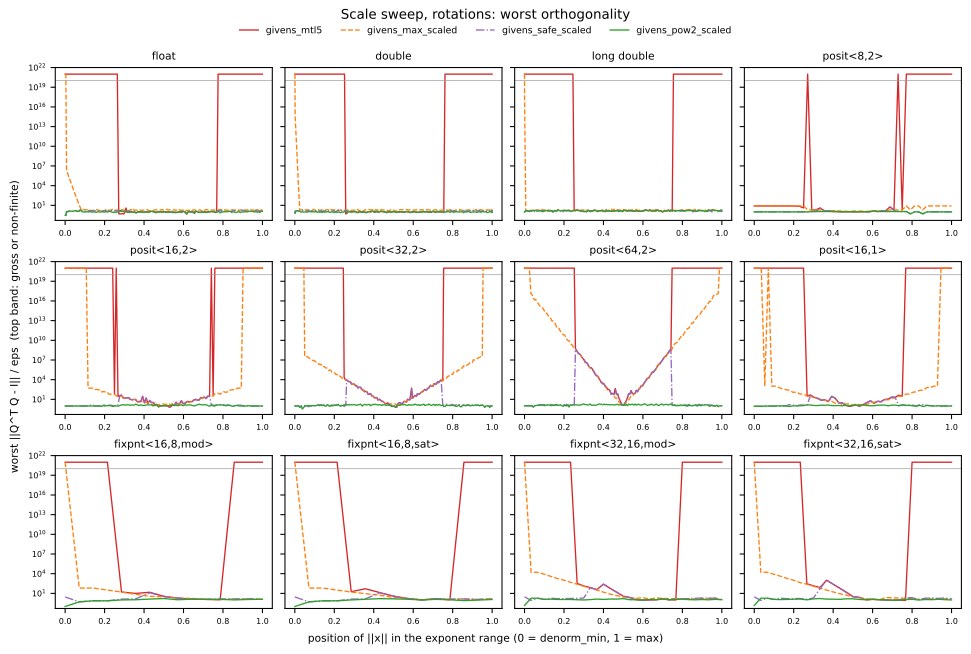
The top band of each panel marks gross or non-finite samples. MTL5’s rotation (red) fails at both ends in IEEE. In a posit or a saturating fixed-point type the square saturates instead, and the rotation is finite and wrong.
The two LAPACK scalings stop the overflow, but each loses precision somewhere:
lapy2’s max-scaling (orange) computes c = a/r, so the error of r at the input’s own magnitude goes into c. That magnitude is subnormal in IEEE, or far from 1 in a posit, where r has few bits. The orthogonality error reaches 1.1×10¹⁵ eps in double near the subnormal range, and 1.4×10¹⁷ eps in posit<64,2>.dlartg’s safe scaling (purple) is what it was designed to be in IEEE: within 2.1 eps over the whole range, in every cfloat from 8 to 256 bits as well. In a posit it never fails grossly. But its thresholds come from where the type overflows (sqrt(min) and sqrt(max/2)), and inside them a posit’s squares fall where it has few bits: 5×10⁸ eps in posit<64,2>.- Power-of-two scaling (green) rounds nothing in a floating-point type and puts the squares near 1. It stays within 2.2 eps in every type except dd and takum, where it stays within 4.6 eps.
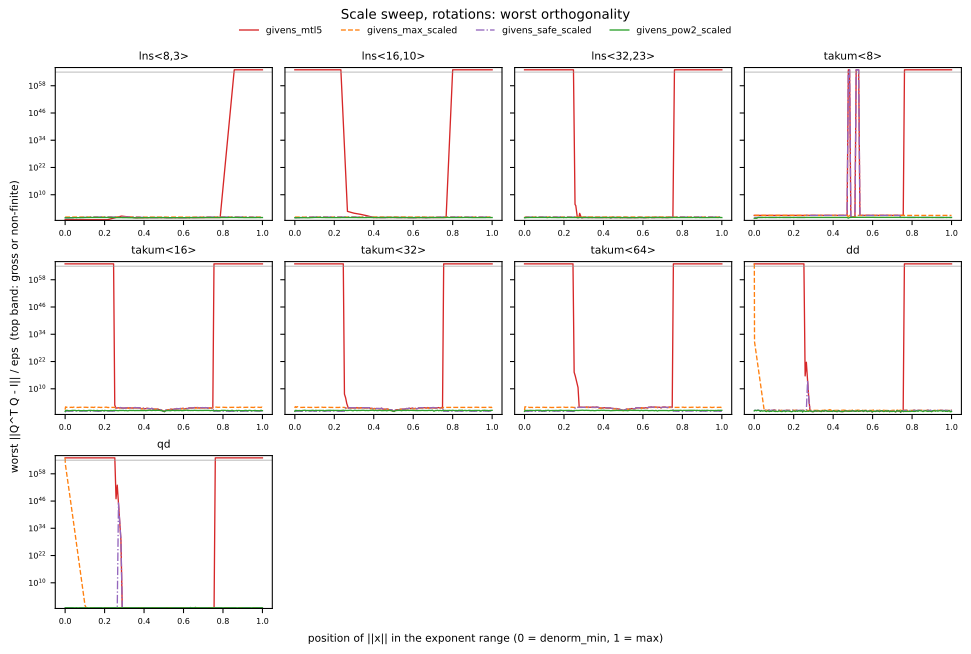
The types added in the second part of the study show the same thing:
- Takums behave like posits, but far more gently:
dlartgreaches 50 to 95 eps, against posit<64,2>‘s 5×10⁸. - dd and qd have full precision only above 2^-969, where the low limb
still fits, but
numeric_limitsreports double’s range. Sodlartg’s thresholds let squares into the degraded zone: 6.5×10¹³ eps in dd and 1.4×10⁴⁵ in qd, both about 2^-59 in absolute terms. - Formats without gradual underflow (lns, and cfloat without subnormals) make the unscaled rotation inaccurate before it fails. A small square flushes or rounds up instead of losing bits gradually: MTL5’s rotation reaches 6.6×10¹³ eps in cfloat<64,11,nosub>, against 1.2 eps with subnormals, and 5.7×10⁵ eps in lns<32,23>.
- The subnormals are also what costs
lapy2its accuracy. In every cfloat without them, the max-scaled rotation stays within 2.7 eps over the whole range.
Reflectors: the sign matters off IEEE
Section titled “Reflectors: the sign matters off IEEE”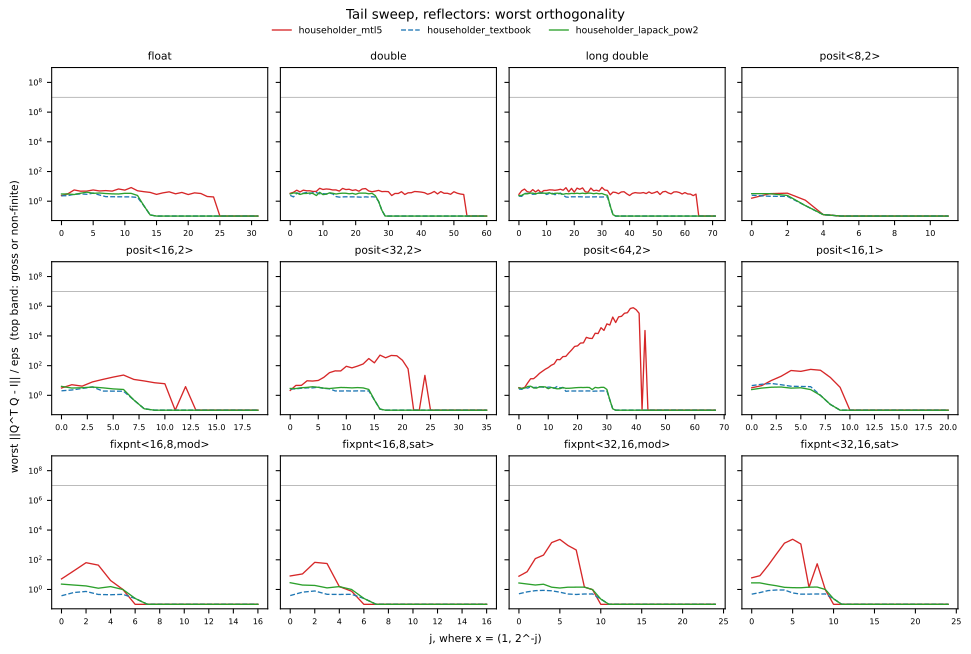
On the tail sweep |x₀| = 1. From j = 1 on, |x₁| < 1, so MTL5’s max-scaling divides by 1 and rounds nothing, and the sign is the only difference between MTL5’s reflector (red) and the LAPACK-sign form (green). At j = 0, |x₁| can exceed 1, and the scaling rounds too.
Parlett’s sign makes v₀ = −σ/(x₀ + ‖x‖) small for a small tail. After normalizing to v(0) = 1, v₁ ≈ −2x₀/x₁ is then large:
- In IEEE that costs nothing: about 9 eps at worst.
- In a posit, v₁ and 1 + v₁² land where the posit has few bits: 512 eps in posit<32,2> and 8×10⁵ in posit<64,2>, and 207 eps in takum<64>.
- In fixed point, which has absolute rather than relative precision, it reaches 2.4×10³ eps in fixpnt<32,16>.
MTL5’s identity fallback (5.21.0) catches the worst of it only once the error exceeds the tail, from j = 40 in posit<64,2>.
With dlarfg’s sign, |v₀| ≥ ‖x‖, so every entry of the normalized v is at
most 1, and householder_lapack_pow2 stays within 8.7 eps in every type, at
every scale and every tail. Its only failures are a few overflows in the top
binade of the 8- and 16-bit IEEE cfloats.
The textbook form has the LAPACK sign too, and on the tail sweep it is within 6.4 eps in IEEE, posits and fixed point. It is unscaled, though, so it shares the unscaled rotation’s half-range limit.
Repeated application
Section titled “Repeated application”One rounded rotation applied k times stretches or shrinks a vector by about k·|c² + s² − 1|/2. At k = 4096 that is 880 to 3.4×10⁴ eps in every type of 16 bits or more, however the rotation was computed. The exception is qd, at 22 to 109 eps, which holds more bits than its eps counts. Accumulating k fresh operators into an 8 × 8 Q grows far more slowly: 30 to 540 eps at k = 1024 in every type of 16 bits or more.
Saturation hides the overflow. In IEEE FP8, some of the repeated-rotation trials end at infinity. In the saturating variants the same trials end clamped at the largest value, with a deviation of 2.3×10³ eps in E4M3, 2.7×10⁵ in E5M2, and 3.9×10⁶ eps for MTL5’s reflector in cfloat<16,5,sat>. The result is wrong, and nothing in the value says so.
What this means for MTL5
Section titled “What this means for MTL5”For double and float nothing here is urgent. The unscaled rotation fails only for inputs outside about 2^-533 to 2^509 in double (10^-160 to 10^153), or 2^-74 to 2^63 in float. The reflector is accurate over the whole range.
For other scalar types:
- The Householder path (
qr_factor) is the safer one when the data’s magnitude is not known to sit near 1. It is clean across every type’s range, though in posits, takums and fixed point its sign costs accuracy on small tails (above). - Expect rotation-based solvers to fail toward the ends of the range. MINRES, GMRES’s Hessenberg QR and the symmetric tridiagonal QR iteration use the unscaled rotation. It loses about half the exponent range in nearly every type tested. In posit<64,2> and takum<64> it also loses most of the precision inside that band: 5×10⁸ and 1.9×10¹⁷ eps.
- Don’t trust thresholds taken from
std::numeric_limitsin a tapered type or in dd. They describe where a type overflows, not where it is precise.
The study suggests two changes. Neither is made yet:
- Scale
apply_givens_rotation, and the same formula in MINRES and the symmetric QR iteration, by an exact power of two before squaring. In IEEE this costs two exponent extractions and removes the half-range limit. In the other types it also keeps the accuracy. - Reflect onto −sign(x₀)‖x‖e₁, as
dlarfgdoes. This changes the sign of R’s diagonal, which MTL5 currently keeps non-negative for x₀ > 0. See Householder reflector forms for what callers pinned to a sign depend on.
Universal behaviour met along the way
Section titled “Universal behaviour met along the way”The study worked around these, and they are filed in Universal:
- universal#1881.
The Dekker
splitrounds the high half of a double nearDBL_MAXup to 2^1024, sodd(DBL_MAX) * dd(0x1p-512)is a NaN. The same split makes dd and qd multiplication and division, and dd_cascade’s division, return NaN at the top of the range. - universal#1882.
numeric_limits<dd>::max()is not a normalized pair: it converts to an infinity, andmax() * 1is NaN.- dd’s
min()(2^-969) disagrees with itsmin_exponent(double’s −1021). - dd_cascade’s
min()isdenorm_min().
- universal#1883.
dd’s
sqrtis off by up to 7.9 units of 2^-106, where dd_cascade’s is within 0.75.
Reproducing
Section titled “Reproducing”The study’s own write-up, with every figure and the full tables, is published
on the mp-numerics site as
Givens rotations and Householder reflectors, one at a time.
The harness, the CSVs with their .sysinfo sidecars, all twelve figures and
the full tables are in
mp-numerics/benchmarks/linalg/givens_householder.
The figures on this page are copied unchanged from that commit. The full run
takes about four minutes, and its CSVs are byte-identical between GCC 15 and
Clang 21 on x86-64.